
dc780245750567f1f7aaf16e21042282

Data Science Roadmap: Your Complete 2026 Guide

Are you a Nigerian beginner who wants a clear data science roadmap? Good news: your search ends here. Abuja Data School is Nigeria’s top live AI training centre. This guide gives you the complete, honest roadmap from zero to your first Nigerian data science job. Every stage is explained clearly: what to learn, in what order, how long it takes, and which free tools to use. No fluff, no detours.

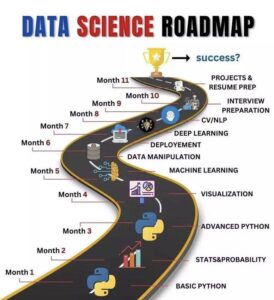
To begin with, this roadmap is divided into six stages: Excel and data basics, Python, pandas and data analysis, machine learning, specialisation, and portfolio development with job search. Furthermore, it maps each stage to Abuja Data School courses and free tools. As a result, by the end of the roadmap, you will have one clear learning path and one practical next step to advance your data career.
 

832ee5b200c035477617a3a3eabc79a3

Why Nigerian Beginners Need a Clear Roadmap

Data science is a wide field. Without a roadmap, most Nigerian beginners get lost. They jump between YouTube videos, try random Udemy courses, learn things out of order, and give up after a few months. The key problem is not a lack of content. It is a lack of a clear path.

Also, the Nigerian data science job market has specific requirements. Abuja banks want pandas and SQL. Lagos fintechs want Python and ML. Abuja NGOs want Excel, Power BI, and data storytelling. In short, a roadmap that works for a Nigerian data science career must reflect what Nigerian employers actually hire for.


The Complete Data Science Roadmap for Nigerian Beginners

Stage
What to Learn
Key Output
1 Excel: data entry, formulas, pivot tables, basic charts Clean, analyse, and chart a Nigerian data set in Excel
2 Python basics: variables, lists, loops, functions, file I/O Write Python scripts that load and process Nigerian data
3 pandas, NumPy, Matplotlib: EDA, cleaning, visualisation Full EDA notebook on a real Nigerian data set on GitHub
4 SQL: SELECT, JOIN, GROUP BY, subqueries Answer 10 business questions on a Nigerian SQL database
5 Machine learning: scikit-learn, supervised models, evaluation Trained, evaluated ML model on Nigerian data on GitHub
6 Specialise + build portfolio + job search 3-5 project GitHub portfolio, LinkedIn, first Nigerian role


In short, every stage builds on the one before. Also, every stage produces a real output you can put on GitHub. In short, by Stage 6, you have a live Nigerian data science portfolio that any Abuja or Lagos employer can review.


Stage 1: Excel and Data Basics

Excel is the entry point and is listed on almost every Nigerian analyst job ad. Every Nigerian data analyst role lists Excel as a core requirement; banks, NGOs, and government agencies all run on it. Start here.

What to cover:

  • Basic formulas: SUM, AVERAGE, COUNT, IF, VLOOKUP, XLOOKUP.
  • Pivot tables: summarise large Nigerian data sets in seconds.
  • Charts: bar charts, line charts, and pie charts for Nigerian reports.
  • Conditional formatting: highlight key values in a Nigerian bank data set.
  • Data cleaning in Excel: remove duplicates, fix formats, fill blanks.

Also, Power BI is a strong add-on at this stage for Nigerians in NGOs, government, or consulting. A basic Power BI dashboard is a strong first portfolio piece. In short, strong Excel and Power BI skills are the fastest way for any Nigerian to get a first data role and start earning while learning more advanced skills.


Stage 2: Python Basics

Python is the core language of data science and is used in every Nigerian ML role. Learn it the right way: write real code from day one.

What to cover:

  • Variables and data types: strings, integers, floats, booleans.
  • Lists, dictionaries, and sets.
  • For loops, while loops, and if/else statements.
  • Functions: define your own reusable blocks of code.
  • File I/O: open, read, and write CSV and text files.
  • Error handling: try/except blocks.

Use Google Colab. It is free, runs in your browser, and has all key libraries pre-installed. No setup is needed. Also, practise on Nigerian data from the start: read a CSV of Abuja transactions, filter it, and print a summary. In short, apply every concept to a Nigerian problem from your first week of Python.


Stage 3: pandas, NumPy, and Data Visualisation.

This stage is the most important for Nigerian data analyst roles. pandas is the core tool for every data scientist and analyst in Nigeria.

What to cover:

  • pandas: Load CSVs, filter rows, group by, aggregate, join data frames, handle missing values, sort, and reset index.
  • NumPy: Array operations, broadcasting, and vectorised maths on Nigerian data columns.
  • Matplotlib and Seaborn: Bar charts, line charts, histograms, heatmaps, and scatter plots.
  • Exploratory data analysis (EDA): A full EDA workflow: load data, check shape and types, count missing values, plot distributions, find correlations.

Key output: a full EDA Jupyter notebook on a real Nigerian data set pushed to GitHub. This is one of the most powerful early portfolio pieces for any Nigerian data scientist. Also, Kaggle has free Nigerian and African data sets you can use. In short, your Stage 3 output is your first proof that you can do real data analysis on Nigerian data.


Stage 4: SQL

SQL is required for most Nigerian data analyst and data scientist roles. Banks, fintechs, NGOs, and government agencies all store their data in relational databases.

What to cover:

  • SELECT, WHERE, ORDER BY, LIMIT.
  • GROUP BY and aggregate functions: COUNT, SUM, AVG, MAX, MIN.
  • JOINs: INNER JOIN, LEFT JOIN, and RIGHT JOIN.
  • Subqueries and common table expressions (CTEs).
  • Window functions: ROW_NUMBER, RANK, LEAD, LAG.

Also, practise in a Nigerian context: write SQL queries to find total loan disbursements by state, average transaction size by day, and top 10 Abuja customers by spend. In short, SQL is the bridge between Nigerian raw data and Nigerian business questions.


Stage 5: Machine Learning with scikit-learn

Once you have Python, pandas, and SQL, you are ready for machine learning. This stage is where data analysts become data scientists.

What to cover:

  • Supervised learning: Linear regression, logistic regression, decision trees, random forests, XGBoost.
  • Model evaluation: Accuracy, precision, recall, F1, AUC-ROC, confusion matrix.
  • Cross-validation: K-fold CV, StratifiedKFold.
  • Preprocessing: StandardScaler, LabelEncoder, SimpleImputer.
  • Pipelines: Chain preprocessing and modelling into a clean, reproducible sklearn Pipeline.
  • Feature engineering: Create, transform, encode, and select features from Nigerian data.

Key output: a full ML model on a real Nigerian data set pushed to GitHub with a model card explaining what it does, what data it used, and how it performs. In short, your Stage 5 output is the strongest single item in your Nigerian data science portfolio.


Stage 6: Specialise, Build Your Portfolio, and Get Your First Nigerian Role

By Stage 5, you have a marketable skill. This final stage is about making it visible and getting hired.

Specialise in One Area

Pick one area to go deeper:

  • NLP: If you want to work on Nigerian language data, chatbots, or document analysis.
  • Computer vision: If you want to work on AgTech, healthcare imaging, or ID verification.
  • MLOps and cloud: If you want to deploy models and build production Nigerian AI systems.
  • Data engineering: If you want to build the data pipelines that feed ML models.
  • Business intelligence: If you want to focus on Power BI, dashboards, and Nigerian business reporting.

Build Your GitHub Portfolio

For every Nigerian and global data science role, GitHub is used as your CV. Aim for 3 to 5 strong projects:

  • An EDA project on a Nigerian dataset.
  • One supervised ML model with a clear Nigerian business problem.
  • An unsupervised project (customer segmentation or anomaly detection).
  • One SQL analysis project with a Nigerian business context.
  • One domain project in your specialisation area.

Also, each project needs a clear README explaining the problem, the data, your method, and your key findings. In short, an Abuja employer looking at your GitHub should understand your work in 2 minutes.

Build Your LinkedIn Profile

A strong LinkedIn profile ensures you are found by Nigerian and global recruiters. Update it with every project you push to GitHub. Also, connect with Nigerian data science communities. Moreover, follow Abuja Data School, Nigerian data science groups, and the top Nigerian tech firms. In short, your LinkedIn is your passive job search running 24 hours a day.


Free Resource: Kaggle Learn

In addition to Abuja Data School’s live training, Abuja Data School recommends Kaggle Learn as the best free resource for every stage of this Nigerian data science roadmap. Kaggle offers free, structured micro-courses in Python, pandas, data visualisation, SQL, feature engineering, ML, and deep learning. Also, all courses run in free Kaggle notebooks with no install. Moreover, each course awards a free Kaggle cert. As a result, a Nigerian beginner who works through Kaggle Learn alongside Abuja Data School’s live courses will have both free global cert credentials and the live Nigerian project experience that Abuja employers value most.

Use Kaggle Learn for free, structured supplementary practice. Abuja Data School provides live instruction, real Nigerian data, career support, and the portfolio that gets you hired.


Nigerian Data Science Expectations by Stage

Role Target
Stage Reached
Junior Data Analyst Stage 3 complete
Data Analyst Stage 4 complete
Junior Data Scientist Stage 5 complete
Data Scientist / ML Engineer Specialised (NLP/MLOps)
Senior ML Engineer Senior / Remote

How Abuja Data School Covers This Roadmap

Abuja Data School covers every stage of this roadmap in its live, project-based courses. Here is the mapping:

  • 1: Excel and Power BI: Data Analysis and Power BI courses.
  • 2: Python basics: Python for AI course
  • 3: pandas and EDA: Data Science with Python course.
  • 4: SQL: Data Analysis course
  • 5: Machine Learning: Machine Learning Foundations course
  • 6: Specialisation: Deep Learning, NLP, MLOps, and AI Agents courses.

To explore all courses and find your entry point, visit the Abuja Data School Data Analysis page.


Frequently Asked Questions: Data Science Roadmap Nigeria

Q1: How Long Does This Roadmap Take?

For a Nigerian professional studying part-time (weekends and evenings), Stages 1 to 5 takes it time. Also, Abuja Data School’s courses mean you never need to quit your current job.

Q2: Do I Need a Maths or Computer Science Degree?

No. Teachers, nurses, accountants, civil servants, and business owners have all been trained at Abuja Data School with no prior coding background. What matters is your drive to learn and your consistency. In short, your background does not limit you. Your habits do.

Q3: What Is the Most Important Stage?

Stage 3 (pandas and EDA) is the most important for getting your first Nigerian data role. Most entry-level analyst jobs in Abuja and Lagos test for exactly this skill. Also, Stage 5 (ML) is the most important for moving from analyst to data scientist pay levels. In short, master pandas first. Add ML second.

Q4: Can I Skip Excel and Go Straight to Python?

Yes, but most Nigerian employer roles still test for Excel. A joint Excel and Python skill is stronger than Python alone for most Abuja data analyst roles. In short, do not skip Excel unless you are targeting roles that explicitly require only Python and SQL.


Your Data Science Journey in Nigeria Starts Today: Abuja Data School Is Ready

Ultimately, the Nigerian data science job market is wide open. Banks, fintechs, NGOs, and government agencies all need trained data professionals. The roadmap is clear. The tools are mostly free, the training is available, and the only thing left is the decision to start.

Whether you are at Stage 1 or Stage 4 right now, Abuja Data School has the right course for your current level and your next career goal. Live classes, real Nigerian data, career support, and a strong nationwide Nigerian learning community are all waiting for you.

Start Your Nigerian Data Science Journey at Abuja Data School Today

To that end, do not wait for a perfect moment. Indeed, every Nigerian data scientist now earning or working remotely for a global tech firm started with one course at Abuja Data School. Yours can begin this week. So, visit the Abuja Data School Data Analysis page today, pick your stage, and apply. As a result, your first data skill, your first data project, and your first data science income in Nigeria are just one enrolment at Abuja Data School away.

4e9787bbeb50db9014c4d30ab7e38785

AI, Machine Learning and Deep Learning: Your Complete Guide

Are you confused about the difference between AI, machine learning, and deep learning? If so, your search ends here. Abuja Data School is Nigeria’s top live AI training centre and the clearest guide to these three concepts. Many Nigerians use the terms interchangeably, but they mean very different things. Knowing the difference helps you choose the right learning path and job title to target. So this guide explains all three clearly, with real Nigerian examples at every step.

Also, each concept is mapped to real Nigerian careers and salaries. In addition, it tells you which Abuja Data School courses cover each area and where to start. As a result, by the end, you will have a clear mental model of the AI landscape and a concrete next step.


The Big Picture: AI, ML, and Deep Learning Are Nested

c5402f24386610fec7141eb5749d40a5

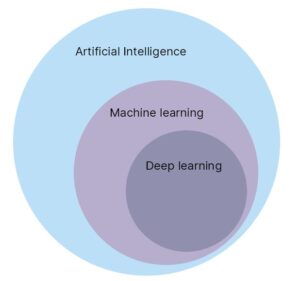
The simplest way to understand the relationship between AI, machine learning, and deep learning is to think of them as three nested circles:

  • AI is the outer circle, the broad idea of making computers intelligent.
  • Machine learning sits inside AI; it is one specific approach to achieving AI.
  • Deep learning sits inside ML; it is one specific type of machine learning.

In short, all deep learning is machine learning, and all machine learning is AI. But not all AI is machine learning, and not all machine learning is deep learning. This distinction matters when you are choosing a career path or a course.


What Is Artificial Intelligence?

AI is the broad field of making computers perform tasks that normally need human thinking. It includes rule-based systems, search algorithms, expert systems, natural language tools, and machine learning. The oldest AI systems in Nigeria, like the automated phone menus at Nigerian banks, use rule-based logic, not ML at all. They follow a fixed decision tree written by a human.

Modern AI includes tools like ChatGPT, Google Maps, and the fraud alert system at your bank. These are all AI, but they use very different techniques. In short, AI is the umbrella. Under it sit dozens of specific techniques, of which machine learning is the most important today.


What Is Machine Learning?

Machine learning is a part of AI where computers learn from data instead of being given explicit rules. In traditional programming, a human writes rules. For example: “If the transaction is above N500,000 and from an unusual location, flag it.” In machine learning, you give the system thousands of examples, and it finds the rules itself.

This is a big shift. Rules are not simply followed by the computer. Patterns in unseen data are found by the model as it learns. The more data it has, the better it gets. In short, machine learning powers modern Nigerian bank fraud detection, loan scoring, and churn prediction.

Types of Machine Learning

There are three main types of ML that Nigerian data scientists work with:

  • Supervised learning: The model learns from labelled data. For example, it is shown thousands of loans labelled “defaulted” or “repaid” and learns to predict which new loan will default.
  • Unsupervised learning: The model finds patterns in unlabelled data. For example, it groups Nigerian bank customers into segments based on spending behaviour, with no prior labels.
  • Reinforcement learning: The model learns by trial and error, receiving rewards for good decisions. This is used in robotics and game-playing AI and is rarer in Nigerian business applications.


What Is Deep Learning?

Deep learning is a type of machine learning that uses neural networks with many layers, hence the word “deep.” Each layer learns to recognise more complex features from the data passed to it.

For example, a deep learning image model might learn in its first layer to detect edges, in the second layer to detect shapes, in the third layer to detect faces, and in the fourth layer to recognise a specific person. The same stacked-layer approach makes large language models like ChatGPT and Claude work. Transformers, the architecture behind most modern AI tools, are a type of deep learning model.

In short, deep learning is what powers the most impressive AI tools of 2026: ChatGPT, image generators, voice cloners, and self-driving cars. But it needs more data, more compute, and more expertise than standard ML.


AI vs ML vs Deep Learning: A Full Comparison Table


Feature Artificial Intelligence Machine Learning Deep Learning
Definition Broad field: machines doing human-like tasks Subset of AI: learning from data Subset of ML: neural networks with many layers
How it works Rules, search, ML, or expert systems Finds patterns in data Stacks layers of neural nets to extract features
Data needed Low (rules can be handwritten) Medium (labelled or unlabelled data sets) Very large (millions of examples often needed)
Compute needed Low to medium Medium Very high (GPUs or TPUs)
Nigerian example Bank phone menu, spam filter Loan default predictor, churn model ChatGPT, fraud image detector, NLP chatbot
Who builds it in Nigeria All AI/data teams Data scientists, ML engineers ML engineers, NLP engineers, AI researchers


Real Nigerian Examples of Each

AI in Nigeria: Everyday Examples

  • GTBank’s automated phone menu uses rule-based AI.
  • MTN’s spam filter uses a mixture of rules and ML.
  • Google Maps route suggestions used by Abuja drivers use AI search algorithms.
  • Abuja Data School’s course recommendation is based on a rule-based AI intake form.

Machine Learning in Nigeria: High-Impact Examples

  • Nigerian banks use supervised ML to score loan applications and predict defaults.
  • Flutterwave uses ML to detect fraudulent transactions in real time.
  • Abuja NGOs use ML to cluster beneficiary data by risk and need.
  • Nigerian telecoms use ML to predict which customers are about to leave.

Deep Learning in Nigeria: Cutting-Edge Examples

  • Lagos fintechs use deep learning NLP to analyse customer complaints and route them automatically.
  • Nigerian EdTech firms use deep learning to build voice-based learning tools in local languages.
  • Abuja health teams use deep learning to analyse chest X-rays for early TB detection.
  • Nigerian media houses use generative deep learning tools for image and audio creation.


Which Path Is Right for You? A Decision Guide


Your Goal Best Starting Point Abuja Data School Course
Use AI tools at work now AI tools and prompt engineering AI Prompt Engineering
Get a data analyst job Python + data science Python for AI + Data Science
Become a data scientist Python + ML Data Science + ML Foundations
Build ML models for Nigerian banks Machine learning ML Foundations
Work on NLP, chatbots, or text AI Deep learning + NLP NLP course
Build an image or voice AI Deep learning Deep Learning course
Become an MLOps engineer ML + cloud deployment MLOps and Cloud AI


Free Resource: 3Blue1Brown Neural Networks Series

In addition to Abuja Data School’s live training, Abuja Data School recommends the 3Blue1Brown Neural Networks YouTube series as the best free visual introduction to how deep learning works. This series uses clear animations to explain neural networks, gradient descent, and backpropagation in a way that any Nigerian with secondary school maths can follow. Also, it is free, available on YouTube, and works on mobile data. Moreover, it is widely used by AI learners worldwide, including Abuja Data School students, as a first visual foundation before jumping into code. As a result, any Nigerian who wants to truly understand what happens inside a deep learning model should watch this series.

That series builds your intuition. Abuja Data School builds your hands-on Python and ML skills. Together, they give you the deepest and most career-ready understanding of machine learning and deep learning available to any Nigerian.


How Abuja Data School Teaches AI, ML, and Deep Learning

Abuja Data School covers all three levels of the AI stack in its live courses. Here is the full learning path:

  • Level 1: AI tools (no code): AI Prompt Engineering and AI for Business courses. Learn to use AI tools effectively with no coding background.
  • Level 2: Machine learning: Python for AI, then Data Science with Python, then ML Foundations. Build real ML models with scikit-learn and real Nigerian data.
  • Level 3: Deep learning: Deep Learning and Neural Nets course, NLP course, and MLOps course. Build and deploy real deep learning models.

To explore the full course path and pick your entry point, visit the Abuja Data School Data Analysis page. Also, read about ML at  https://www.abujadataschool.com/machine-learning-training-in-abuja-your-complete-guide/


Frequently Asked Questions: AI vs ML vs Deep Learning

Q1: Do I Need to Learn AI Before Machine Learning?

No. Most people start directly with machine learning using Python and scikit-learn, then learn the broader AI concepts alongside that. In short, the best entry point is Python, then data science, then ML, not a theory-heavy AI overview first.

Q2: Is Deep Learning Necessary for a Data Science Job in Nigeria?

Not for most Nigerian data science roles. Most Nigerian bank, NGO, and fintech data science jobs require supervised ML, regression, classification, and clustering. Deep learning is more relevant for NLP, image, and voice roles. In short, master ML first. Add deep learning when your career goal specifically needs it.

Q3: Which Pays More in Nigeria: ML or Deep Learning?

Deep learning engineers earn more on average because the skill is rarer. But the gap at the entry level is smaller than people expect. A strong ML engineer with a good GitHub portfolio can earn N700k to N2m per month in Nigeria. Deep learning engineers earn N800k to N4m. In short, both pay very well compared to most Nigerian tech roles. Start with ML and add DL when your portfolio is ready.


Now You Know the Difference, Start Building at Abuja Data School

Ultimately, AI, machine learning, and deep learning are not competing terms. There are three levels of the same technology stack, and you can enter that stack at any level based on your goal. The clearest and fastest path for most Nigerians is: AI tools first (for immediate impact), then ML (for a strong data career), then deep learning (for the highest-paid specialist roles).

To that end, take the next step today. Visit the Abuja Data School Data Analysis page and pick the level that fits your current goal. As a result, your first real AI, ML, or deep learning skill and the Nigerian career it opens, is just one enrolment at Abuja Data School away.

powering-indias-digital-future-the-rise-of-data-centres.

From Data Analyst to Machine Learning Engineer in Nigeria

Are you a data analyst in Nigeria who wants to become a machine learning engineer? If so, you are already closer to that goal than you think. Not only do analysts already have core ML skills — Python, SQL, and statistics — but the gap between the two roles is smaller than most expect. In short, this is one of the most natural and well-paid career transitions in Nigerian tech right now.

Specifically, this guide maps the exact path from data analyst to ML engineer for Nigerian tech workers. Specifically, it covers the new skills to learn, the tools to master, a realistic timeline, and the salary jump you can expect. In addition, it shows the steps to take this week to get started. So, whether you work at a Lagos bank, an Abuja NGO, or a remote firm, this guide gives you a clear, honest roadmap to follow.


So, Why Should Nigerian Data Analysts Move Into Machine Learning?

Simply put, machine learning engineers earn greatly more than data analysts in Nigeria — and globally. While a strong data analyst in Nigeria earns N200,000 to N500,000 per month, a junior ML engineer typically earns N350,000 to N700,000. Senior ML engineers at top Nigerian firms or working remotely for global companies can earn $3,000 to $9,000 USD per month. Furthermore, the demand for ML engineers in Nigeria is growing fast while the supply of trained talent stays thin.

In addition, the move from data analyst to ML engineer does not mean starting over. Rather, it means building on skills you already have. Specifically, data analysts already know Python or R, understand data structures, can clean messy datasets, and think in terms of patterns and trends. Indeed, these are the exact foundations ML engineering sits on. So, the transition is more of a step up than a full career change. As a result, that makes it one of the smartest moves a Nigerian data pro can make right now.

The Nigerian Job Market Needs ML Engineers Urgently

Specifically, here are the key sectors in Nigeria actively hiring ML engineers right now — and paying a premium:

  • Also, fintech and banking: Fraud detection, credit scoring, and churn prediction models are now standard at Access Bank, Flutterwave, Paystack, and Kuda
  • Furthermore, telecoms: MTN, Airtel, and Glo use ML to predict network faults, reduce churn, and personalise customer offers
  • Additionally, e-commerce and retail: Jumia and other Nigerian platforms use tip and demand forecasting models
  • For instance, health tech: Startups like Helium Health and 54gene use ML for clinical data analysis and disease prediction
  • Moreover, government and NGOs: NITDA, CBN, World Bank, and UN agencies hire ML talent for data-heavy policy and programme work
  • Finally, remote global roles: Platforms like Andela, Turing, and Toptal place Nigerian ML engineers with US and European firms at dollar rates


What Data Analysts Already Have That ML Engineers Need

Before listing the new skills to learn, it helps to recognise what you already bring to the table. Specifically, most Nigerian data analysts with two or more years of experience already have a strong head start on the ML path. Here is what counts:

Skills That Transfer Directly

  • For example, Python or R: If you already use Python for data work, you know the main ML language. You just need to add new libraries on top.
  • Also, SQL: Every ML engineer queries databases to pull training data. Your SQL skills transfer directly and are used every single day
  • Furthermore, statistics: Your understanding of mean, variance, distributions, and correlation is the mathematical backbone of machine learning models
  • Additionally, data cleaning: ML models fail on dirty data. Your ability to clean, reshape, and validate datasets is one of the most underrated skills in the ML pipeline
  • Also, data visuals: Plotting data to find patterns is exactly how ML engineers explore features. Your Tableau or Power BI skills apply directly here.
  • Finally, business context: Understanding what a business actually needs from data is rare in pure ML engineers — your analyst background gives you an edge in turning models into real decisions


The New Skills You Need to Make the Transition

So, let us be specific about what you need to add. Specifically, the gap comes down to five key skill areas. Furthermore, each one is learnable in three to six months with focused daily study. So, here is exactly what to build:

1. Machine Learning Fundamentals

First, you need a solid grasp of core ML concepts and algorithms. Specifically, you should be able to explain and implement supervised learning models — linear regression, logistic regression, decision trees, and random forests. In addition, you need to understand unsupervised learning — clustering with K-Means and PCA with PCA. Furthermore, you need to know how to evaluate models using metrics like accuracy, precision, recall, F1 score, and ROC-AUC. Indeed, the best resource for this is Andrew Ng’s Machine Learning Specialization on Coursera — widely seen as the gold standard starting point.

2. Scikit-learn and the Python ML Stack

Next, as a data analyst you likely already use Pandas and NumPy. Now, however, you need to add Scikit-learn — the main Python library for building and testing ML models. Specifically, Scikit-learn lets you train models, tune parameters, build pipelines, and evaluate results in a consistent and clean way. In addition, you should also get comfortable with Matplotlib and Seaborn for model visuals. As a result, you will be able to go from raw data to a trained and evaluated model entirely in Python.

3. Deep Learning Basics

In addition, many ML roles now expect basic deep learning knowledge — the tech behind image recognition, text analysis, and recommendation systems. Specifically, you do not need to master deep learning to get your first ML role. However, you should understand how neural networks work and how to build a simple model in TensorFlow or PyTorch. You also need to know when to use deep learning versus classical ML. Furthermore, the DeepLearning.AI Specialization on Coursera — also by Andrew Ng — is the best structured path for this.

4. Model Deployment and MLOps Basics

Furthermore, one of the biggest gaps between data analysts and ML engineers is deployment. Specifically, data analysts produce reports and dashboards. Specifically, ML engineers build models that run inside live systems — apps, APIs, and automated pipelines. So, you need to learn how to wrap a trained model in a REST API using FastAPI or Flask. You also need to package it with Docker and push it to a cloud platform like AWS or Google Cloud. Not only does this skill set close the gap with senior ML engineers, but it also makes you far more hireable right away.

5. Version Control and Collaborative Coding

Also, data analysts often work alone in Excel or Jupyter notebooks. ML engineers work in teams using Git and GitHub to manage code, track changes, and review each other’s work. Specifically, you need to be comfortable with basic Git commands — clone, branch, commit, push, pull, and merge. In addition, a strong GitHub profile with real ML project code is now one of the first things ML employers check. Most look at it before they even read your CV. So, start building yours now.


A Realistic 6-Month Transition Timeline for Nigerian Analysts

So, how long does the transition actually take? Based on working Nigerian tech careers, here is a realistic month-by-month plan for a data analyst studying part-time at five to seven hours per week:

Month Focus Area Key Resources Milestone
Month 1 ML fundamentals + Scikit-learn Andrew Ng (Coursera), Kaggle Learn Train your first 3 ML models
Month 2 Model evaluation + feature engineering Scikit-learn docs, Kaggle notebooks Complete a full Kaggle mini-project
Month 3 Deep learning basics DeepLearning.AI (Coursera), fast.ai Build a neural net from scratch
Month 4 Model deployment + APIs FastAPI docs, AWS free tier, Docker Deploy a model as a live API
Month 5 MLOps basics + Git/GitHub MLflow docs, GitHub guides Push 2 projects to GitHub publicly
Month 6 Portfolio + job applications LinkedIn, Andela, Turing, Upwork Apply to 10+ ML roles per week


The Salary Jump: What to Expect After the Transition

Indeed, one of the strongest reasons to make this move is the pay difference. Specifically, here is what the salary progression looks like for Nigerian tech workers who make the switch from data analyst to ML engineer:

Role Nigeria (Local) Remote (USD/mo) Experience Level
Junior Data Analyst N150k–N280k/mo $800–$1,500 0–2 years
Senior Data Analyst N280k–N500k/mo $1,500–$3,000 2–5 years
Junior ML Engineer N350k–N700k/mo $2,500–$5,000 0–2 years (post-transition)
Mid-Level ML Engineer N600k–N1.2m/mo $5,000–$8,000 2–4 years
Senior ML Engineer N1m–N2m+/mo $7,000–$12,000 4+ years
MLOps / AI Lead N1.5m–N3m+/mo $10,000–$18,000 5+ years


How to Stand Out as a Nigerian ML Engineer in the Job Market

However, learning the skills is only half the job. Specifically, the Nigerian and global ML job market is tough. The candidates who get hired fastest are those who show their work clearly and build the right name for themselves. Here is how to stand out:

Build a Strong GitHub Portfolio

First, your GitHub profile is your live CV. Specifically, aim to have at least three to five well-documented ML projects on GitHub before you apply for your first ML role. Specifically, each project should have a clear README that explains the problem, the data, the model, and the results. Furthermore, pick projects tied to Nigerian business problems — fraud detection for fintech, crop yield for agri-tech, or disease risk for health NGOs. As a result, your work will stand out from the hundreds of generic tutorial projects that most candidates submit.

Compete on Kaggle

Next, Kaggle competitions are one of the fastest ways to prove ML skills to employers without a formal ML job title yet. Specifically, entering even beginner Kaggle competitions gives you real practice on messy data. It also forces you to compare your models against others and builds a public track record of your ML work. In addition, a top-20% finish on any Kaggle competition is a credible signal that Nigerian and global employers recognise. So, join your first Kaggle competition this week — even if you do not finish in the top ranks, the practice alone is worth it.

Get the Right Certificates

In addition, the right certs signal to employers that you have covered the core curriculum in a structured way. Specifically, three certs carry the most weight: the ML Specialization by Andrew Ng on Coursera, the DeepLearning.AI TensorFlow Developer cert, and the AWS Certified Machine Learning Specialty. Furthermore, these three together show breadth across ML theory, deep learning, and cloud deployment — which is exactly what most ML job specs ask for.

Join the Nigerian Data and ML Community

Also, your network matters as much as your skills in the Nigerian tech job market. Specifically, join Data Science Nigeria, the Lagos Data Science Meetup, and the Abuja Tech Hub. All of these run events, mentorship cycles, and job referral channels. Furthermore, posting about your ML journey on LinkedIn builds visibility with Nigerian tech recruiters. They actively scout the platform for emerging talent. As a result, community involvement often leads to job opportunities faster than cold applications alone.


Frequently Asked Questions (FAQs)

Q1: So, How Long Does the Transition Take From Data Analyst to ML Engineer in Nigeria?

Generally, for most Nigerian data analysts, the full transition takes six to twelve months of consistent part-time study. Specifically, analysts with strong Python and statistics backgrounds tend to move faster — often in six months. Those who need to build Python skills from scratch may take nine to twelve months. In addition, the timeline shortens greatly if you follow a structured path. A programme like Abuja Data School or Andrew Ng’s Coursera Specialization is far more effective than learning randomly from YouTube alone.

Q2: Furthermore, Do I Need a New Degree to Become an ML Engineer in Nigeria?

No, you do not need one. Specifically, most ML engineering roles in Nigerian tech firms and global remote companies do not require a new degree. What they want is a strong portfolio of ML projects, relevant certs, and the ability to pass a technical interview. In addition, platforms like Andela, Turing, and Toptal assess Nigerian candidates purely on skills and project quality — not on academic qualifications. So, invest your time in learning and building, not in applying for a new degree programme.

Q3: Also, Is Python Enough or Do I Need to Learn Other Languages?

Indeed, Python is enough for the vast majority of ML roles in Nigeria and globally. Specifically, Python plus Scikit-learn, TensorFlow or PyTorch, and FastAPI for deployment covers over 90% of what ML engineer job specs require. In addition, SQL remains essential for data access and prep work. So, if you already know Python and SQL, you have the two most important languages you need. The rest is just libraries and frameworks built on top of Python.

Q4: Additionally, Can I Transition While Working Full-Time as a Data Analyst in Nigeria?

Yes — and indeed many Nigerian data analysts do exactly this. Specifically, one hour each weekday plus three to four hours on weekends adds up to eight to ten hours per week. At that pace, the six-month transition timeline is very realistic. Furthermore, your current data analyst job actually helps the transition because you can apply new ML concepts to your existing work data in practice. As a result, you learn faster and build relevant local portfolio projects at the same time.

Q5: Finally, What Is the Best First ML Project for a Nigerian Data Analyst to Build?

The best first project is one that uses data you already understand from your current work. Specifically, if you work in finance, build a loan default prediction model. If you work in telecoms, build a customer churn model. If you work in health, build a patient readmission risk model. These are real problems Nigerian employers know well. A working model built on local data shows far more than any generic tutorial project. In addition, publish it on GitHub with a clear write-up and share it on LinkedIn to start building your ML public profile today.


Conclusion

Ultimately, the path from data analyst to ML engineer is one of the clearest and most rewarding moves for Nigerian tech workers in 2025. Not only do you already have the foundation — Python, SQL, and stats — but the new skills are all learnable in six focused months. In addition, the salary jump is real and the demand is strong. The global remote market gives Abuja and Lagos-based ML engineers access to dollar income without leaving Nigeria.

Your Move Starts Today

To that end, do not wait until you feel fully ready — start with one course this week. Specifically, enrol in Andrew Ng’s Machine Learning Specialization on Coursera, create a free Kaggle account, and push your first ML notebook to GitHub. Above all, every senior ML engineer in Nigeria started exactly where you are right now. As a result, your first ML job offer, your first remote contract, and your first dollar pay cheque are all just six consistent months away. Start today.

https://www.abujadataschool.com/artificial-intelligence-and-robotics-training-in-abuja-nigeria/

Hi, How Can We Help You?