Are you confused about the difference between AI, machine learning, and deep learning? If so, your search ends here. Abuja Data School is Nigeria’s top live AI training centre and the clearest guide to these three concepts. Many Nigerians use the terms interchangeably, but they mean very different things. Knowing the difference helps you choose the right learning path and job title to target. So this guide explains all three clearly, with real Nigerian examples at every step.
Also, each concept is mapped to real Nigerian careers and salaries. In addition, it tells you which Abuja Data School courses cover each area and where to start. As a result, by the end, you will have a clear mental model of the AI landscape and a concrete next step.
The Big Picture: AI, ML, and Deep Learning Are Nested
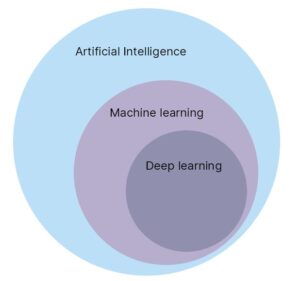
The simplest way to understand the relationship between AI, machine learning, and deep learning is to think of them as three nested circles:
- AI is the outer circle, the broad idea of making computers intelligent.
- Machine learning sits inside AI; it is one specific approach to achieving AI.
- Deep learning sits inside ML; it is one specific type of machine learning.
In short, all deep learning is machine learning, and all machine learning is AI. But not all AI is machine learning, and not all machine learning is deep learning. This distinction matters when you are choosing a career path or a course.
What Is Artificial Intelligence?
AI is the broad field of making computers perform tasks that normally need human thinking. It includes rule-based systems, search algorithms, expert systems, natural language tools, and machine learning. The oldest AI systems in Nigeria, like the automated phone menus at Nigerian banks, use rule-based logic, not ML at all. They follow a fixed decision tree written by a human.
Modern AI includes tools like ChatGPT, Google Maps, and the fraud alert system at your bank. These are all AI, but they use very different techniques. In short, AI is the umbrella. Under it sit dozens of specific techniques, of which machine learning is the most important today.
What Is Machine Learning?
Machine learning is a part of AI where computers learn from data instead of being given explicit rules. In traditional programming, a human writes rules. For example: “If the transaction is above N500,000 and from an unusual location, flag it.” In machine learning, you give the system thousands of examples, and it finds the rules itself.
This is a big shift. Rules are not simply followed by the computer. Patterns in unseen data are found by the model as it learns. The more data it has, the better it gets. In short, machine learning powers modern Nigerian bank fraud detection, loan scoring, and churn prediction.
Types of Machine Learning
There are three main types of ML that Nigerian data scientists work with:
- Supervised learning: The model learns from labelled data. For example, it is shown thousands of loans labelled “defaulted” or “repaid” and learns to predict which new loan will default.
- Unsupervised learning: The model finds patterns in unlabelled data. For example, it groups Nigerian bank customers into segments based on spending behaviour, with no prior labels.
- Reinforcement learning: The model learns by trial and error, receiving rewards for good decisions. This is used in robotics and game-playing AI and is rarer in Nigerian business applications.
What Is Deep Learning?
Deep learning is a type of machine learning that uses neural networks with many layers, hence the word “deep.” Each layer learns to recognise more complex features from the data passed to it.
For example, a deep learning image model might learn in its first layer to detect edges, in the second layer to detect shapes, in the third layer to detect faces, and in the fourth layer to recognise a specific person. The same stacked-layer approach makes large language models like ChatGPT and Claude work. Transformers, the architecture behind most modern AI tools, are a type of deep learning model.
In short, deep learning is what powers the most impressive AI tools of 2026: ChatGPT, image generators, voice cloners, and self-driving cars. But it needs more data, more compute, and more expertise than standard ML.
AI vs ML vs Deep Learning: A Full Comparison Table
| Feature | Artificial Intelligence | Machine Learning | Deep Learning |
| Definition | Broad field: machines doing human-like tasks | Subset of AI: learning from data | Subset of ML: neural networks with many layers |
| How it works | Rules, search, ML, or expert systems | Finds patterns in data | Stacks layers of neural nets to extract features |
| Data needed | Low (rules can be handwritten) | Medium (labelled or unlabelled data sets) | Very large (millions of examples often needed) |
| Compute needed | Low to medium | Medium | Very high (GPUs or TPUs) |
| Nigerian example | Bank phone menu, spam filter | Loan default predictor, churn model | ChatGPT, fraud image detector, NLP chatbot |
| Who builds it in Nigeria | All AI/data teams | Data scientists, ML engineers | ML engineers, NLP engineers, AI researchers |
Real Nigerian Examples of Each
AI in Nigeria: Everyday Examples
- GTBank’s automated phone menu uses rule-based AI.
- MTN’s spam filter uses a mixture of rules and ML.
- Google Maps route suggestions used by Abuja drivers use AI search algorithms.
- Abuja Data School’s course recommendation is based on a rule-based AI intake form.
Machine Learning in Nigeria: High-Impact Examples
- Nigerian banks use supervised ML to score loan applications and predict defaults.
- Flutterwave uses ML to detect fraudulent transactions in real time.
- Abuja NGOs use ML to cluster beneficiary data by risk and need.
- Nigerian telecoms use ML to predict which customers are about to leave.
Deep Learning in Nigeria: Cutting-Edge Examples
- Lagos fintechs use deep learning NLP to analyse customer complaints and route them automatically.
- Nigerian EdTech firms use deep learning to build voice-based learning tools in local languages.
- Abuja health teams use deep learning to analyse chest X-rays for early TB detection.
- Nigerian media houses use generative deep learning tools for image and audio creation.
Which Path Is Right for You? A Decision Guide
| Your Goal | Best Starting Point | Abuja Data School Course |
| Use AI tools at work now | AI tools and prompt engineering | AI Prompt Engineering |
| Get a data analyst job | Python + data science | Python for AI + Data Science |
| Become a data scientist | Python + ML | Data Science + ML Foundations |
| Build ML models for Nigerian banks | Machine learning | ML Foundations |
| Work on NLP, chatbots, or text AI | Deep learning + NLP | NLP course |
| Build an image or voice AI | Deep learning | Deep Learning course |
| Become an MLOps engineer | ML + cloud deployment | MLOps and Cloud AI |
Free Resource: 3Blue1Brown Neural Networks Series
In addition to Abuja Data School’s live training, Abuja Data School recommends the 3Blue1Brown Neural Networks YouTube series as the best free visual introduction to how deep learning works. This series uses clear animations to explain neural networks, gradient descent, and backpropagation in a way that any Nigerian with secondary school maths can follow. Also, it is free, available on YouTube, and works on mobile data. Moreover, it is widely used by AI learners worldwide, including Abuja Data School students, as a first visual foundation before jumping into code. As a result, any Nigerian who wants to truly understand what happens inside a deep learning model should watch this series.
That series builds your intuition. Abuja Data School builds your hands-on Python and ML skills. Together, they give you the deepest and most career-ready understanding of machine learning and deep learning available to any Nigerian.
How Abuja Data School Teaches AI, ML, and Deep Learning
Abuja Data School covers all three levels of the AI stack in its live courses. Here is the full learning path:
- Level 1: AI tools (no code): AI Prompt Engineering and AI for Business courses. Learn to use AI tools effectively with no coding background.
- Level 2: Machine learning: Python for AI, then Data Science with Python, then ML Foundations. Build real ML models with scikit-learn and real Nigerian data.
- Level 3: Deep learning: Deep Learning and Neural Nets course, NLP course, and MLOps course. Build and deploy real deep learning models.
To explore the full course path and pick your entry point, visit the Abuja Data School Data Analysis page. Also, read about ML at https://www.abujadataschool.com/machine-learning-training-in-abuja-your-complete-guide/
Frequently Asked Questions: AI vs ML vs Deep Learning
Q1: Do I Need to Learn AI Before Machine Learning?
No. Most people start directly with machine learning using Python and scikit-learn, then learn the broader AI concepts alongside that. In short, the best entry point is Python, then data science, then ML, not a theory-heavy AI overview first.
Q2: Is Deep Learning Necessary for a Data Science Job in Nigeria?
Not for most Nigerian data science roles. Most Nigerian bank, NGO, and fintech data science jobs require supervised ML, regression, classification, and clustering. Deep learning is more relevant for NLP, image, and voice roles. In short, master ML first. Add deep learning when your career goal specifically needs it.
Q3: Which Pays More in Nigeria: ML or Deep Learning?
Deep learning engineers earn more on average because the skill is rarer. But the gap at the entry level is smaller than people expect. A strong ML engineer with a good GitHub portfolio can earn N700k to N2m per month in Nigeria. Deep learning engineers earn N800k to N4m. In short, both pay very well compared to most Nigerian tech roles. Start with ML and add DL when your portfolio is ready.
Now You Know the Difference, Start Building at Abuja Data School
Ultimately, AI, machine learning, and deep learning are not competing terms. There are three levels of the same technology stack, and you can enter that stack at any level based on your goal. The clearest and fastest path for most Nigerians is: AI tools first (for immediate impact), then ML (for a strong data career), then deep learning (for the highest-paid specialist roles).
To that end, take the next step today. Visit the Abuja Data School Data Analysis page and pick the level that fits your current goal. As a result, your first real AI, ML, or deep learning skill and the Nigerian career it opens, is just one enrolment at Abuja Data School away.