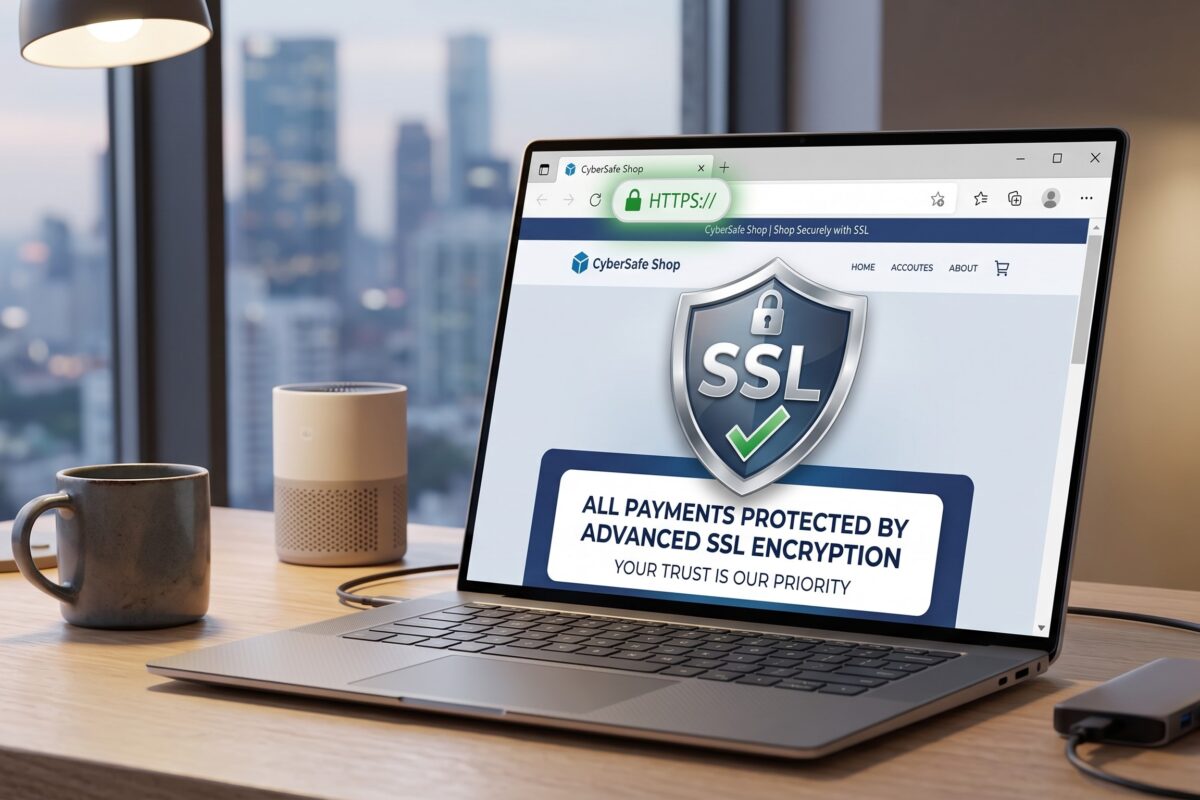
This guide explains how to secure your Nigerian website with SSL and HTTPS. Abuja Data School is Nigeria’s top live technology training centre. SSL and HTTPS are not optional extras for a professional Nigerian website in 2026; they are baseline requirements. A website without HTTPS shows a “Not Secure” warning in Chrome, loses Google search ranking, and pushes away Nigerian visitors the moment they see it. In short, SSL is the fastest, cheapest upgrade any Nigerian website owner can make today.
So, this guide covers what SSL and HTTPS are, why every Nigerian website needs them, the different types of SSL certificates, how to get a free SSL certificate, and the step-by-step setup process for WordPress and custom HTML sites. It also covers how to fix the most common SSL errors on Nigerian websites. By the end of this guide, your Nigerian website will be secure and show the HTTPS padlock your visitors and Google expect.
What Is SSL? A Plain-English Explanation
SSL stands for Secure Sockets Layer. Also, it is the technology that creates an encrypted connection between your visitor’s browser and your website’s server. When SSL activates, data that travels between the browser and server, such as a name, email, password, or payment card number, gets scrambled so that no third party can read it in transit.
Furthermore, TLS (Transport Layer Security) is the modern, updated version of SSL. Also, most people still call it SSL even though TLS now does the work. In short, SSL/TLS is the encryption system that makes HTTPS possible and keeps Nigerian visitor data safe.

What Is HTTPS and How Is It Different From HTTP?
HTTP (Hypertext Transfer Protocol) is the standard system for transferring data between a browser and a server. Also, HTTP sends data in plain text, which means anyone on the same network can intercept and read it. HTTPS (HTTP Secure) adds an SSL/TLS layer that encrypts all data in transit.
Here is what changes visually when HTTPS is active on a Nigerian website:
Padlock icon: A padlock appears in the browser address bar, signalling that the connection is secure.
https:// prefix: Your domain changes from http://yoursite.com to https://yoursite.com.
No “Not Secure” warning: Chrome, Firefox, and all major browsers stop showing the “Not Secure” label that drives Nigerian visitors away.
In short, HTTPS is what Nigerian visitors and Google both look for before trusting a website. Furthermore, it is required for any Nigerian website that collects data, processes payments, or runs a login system.
Why Every Nigerian Website Needs HTTPS in 2026
Google ranking: Google treats HTTPS as a confirmed ranking signal. Also, two Nigerian websites that are otherwise identical in quality will differ in Google ranking if one has HTTPS and the other does not. HTTP sites rank lower in Nigerian Google search results.
Browser warnings: Chrome, which most Nigerian internet users run on Android phones, labels all HTTP sites as “Not Secure”. Furthermore, this warning appears before a visitor reads a single word on your page. In short, the warning alone loses a significant percentage of Nigerian visitors before they engage.
Nigerian visitor trust: Nigerian online shoppers, NGO donors, and professional clients check for the padlock before submitting any form or payment. Also, without HTTPS, Nigerian visitors hesitate to share contact details or card numbers. In short, HTTPS is your first trust signal.
Data protection: Contact form submissions, login credentials, and payment details need encryption. Also, any Nigerian website that collects data without HTTPS exposes its users to interception. Furthermore, this creates both ethical and legal exposure for Nigerian website owners.
PWA and modern web features: Progressive Web App features, service workers, and many modern browser APIs only work on HTTPS sites. Also, some Nigerian hosting features like push notifications require HTTPS. In short, HTTPS unlocks the full capability of the modern web.
Types of SSL Certificates: Which Does Your Nigerian Website Need?
Certificate Type
What It Covers
Best For Nigerian Use
Domain Validation (DV)
One domain. Basic identity check.
Blogs, portfolios, small biz sites
Wildcard SSL
One domain + all subdomains
Sites with subdomains (shop.domain.com)
Organisation Validation (OV)
Domain and company identity verified
Medium Nigerian businesses and NGOs
Extended Validation (EV)
Full legal company verification
Banks, fintechs, large e-commerce
Multi-Domain (SAN)
Multiple different domains in one cert
Agencies managing several client sites
In short, a free Let’s Encrypt DV certificate covers the SSL needs of over 95 per cent of Nigerian websites. Also, most reputable Nigerian hosting providers now include Let’s Encrypt SSL at no cost with every hosting plan. Furthermore, EV and OV certificates are only worth the extra cost for Nigerian financial institutions, large e-commerce platforms, and organisations that must show verified identity in the browser bar.
How to Get a Free SSL Certificate for Your Nigerian Website
Method 1: SSL via Your Hosting Control Panel (Easiest)
Most Nigerian hosting providers, including Namecheap, SiteGround, Whogohost, and Web4Africa, now offer free Let’s Encrypt SSL directly from cPanel. Here is the process:
Log in to your cPanel account.
Scroll to the “Security” section and click “SSL/TLS Status” or “Let’s Encrypt SSL”.
Select your domain from the list and click “Install”.
Wait 2 to 5 minutes for the certificate to issue and install.
Your site now shows https:// in the browser address bar.
In short, Let’s Encrypt SSL via cPanel is free, takes under 5 minutes, and works on any Nigerian shared hosting plan.
Method 2: SSL via Cloudflare (Best Free Option for All Sites)
Cloudflare offers free SSL as part of its free CDN plan. Also, this is the best option for Nigerian websites that want both SSL and CDN performance in one step. Here is how:
Create a free Cloudflare account at cloudflare.com.
Add your Nigerian website domain to Cloudflare.
Update your domain’s nameservers to the ones Cloudflare provides (do this at your domain registrar).
Cloudflare activates SSL automatically within minutes. Also, choose “Full” SSL mode in Cloudflare’s SSL/TLS settings.
Furthermore, Cloudflare’s free SSL also protects against DDoS attacks and speeds up your Nigerian site via CDN. In short, Cloudflare SSL is the most powerful free security upgrade any Nigerian website owner can activate today.
Method 3: WordPress SSL Setup
For Nigerian WordPress sites, activate SSL in three steps: first, install the free SSL certificate through cPanel (Method 1 above); second, install the free Really Simple SSL plugin from the WordPress plugin directory; third, activate the plugin, and it automatically redirects all HTTP traffic to HTTPS. Also, the plugin fixes mixed content warnings caused by internal links still pointing to http://. In short, the Really Simple SSL plugin makes SSL setup effortless on any Nigerian WordPress site.
How to Force HTTPS and Fix Mixed Content Warnings
After installing SSL, Nigerian website owners often encounter “mixed content” warnings where some page elements (images, scripts, or stylesheets) still load over HTTP instead of HTTPS. Also, mixed content warnings prevent the padlock from showing correctly. Here is how to fix them:
For WordPress: The Really Simple SSL plugin handles most mixed content automatically. For remaining issues, use the Better Search Replace plugin to update all http:// references in your database to https://.
For custom HTML sites: Search every HTML and CSS file for http:// and replace with https://. Furthermore, check any embedded iframes, CDN links, and third-party script tags.
Force HTTPS via htaccess: Add these lines to your htaccess file to redirect all HTTP requests to HTTPS automatically: RewriteEngine On / RewriteCond %{HTTPS} off / RewriteRule (.*) https://%{HTTP_HOST}%{REQUEST_URI} [R=301, L]
In short, a correctly set up Nigerian website shows a solid padlock with no mixed content warnings. Also, Chrome DevTools (F12 → Console) shows any remaining mixed content errors to fix.
Common SSL Errors on Nigerian Websites and How to Fix Them
SSL Error
Likely Cause
Fix
ERR_SSL_PROTOCOL_ERROR
SSL not installed or certificate expired
Install or renew SSL via cPanel or Cloudflare.
NET::ERR_CERT_AUTHORITY_INVALID
Self-signed or untrusted certificate
Replace with Let’s Encrypt or Cloudflare SSL.
Mixed content warning (padlock broken)
Some page elements still load over HTTP
Use the Really Simple SSL plugin or update all http:// to https://.
The SSL certificate expired.
Let’s Encrypt certificate not auto-renewed
Enable auto-renew in cPanel or Cloudflare.
Too many redirects
Conflicting redirect rules in .htaccess
Clear redirect rules and re-add the standard HTTPS redirect.
ERR_CERT_COMMON_NAME_INVALID
Certificate issued for a different domain
Reissue the certificate for the correct Nigerian domain.
Free Resource: Let’s Encrypt Documentation
In addition to Abuja Data School’s live training, Abuja Data School recommends the Let’s Encrypt Documentation as the best free technical resource for Nigerian website owners who want to understand SSL certificates in depth. Let’s Encrypt is the non-profit certificate authority that powers most free Nigerian website SSL certificates. Also, their documentation covers how certificates work, auto-renewal, troubleshooting, and manual installation for developers who manage their own Nigerian servers. Moreover, all Let’s Encrypt documentation is free to read with no account required. As a result, any Nigerian who reads the Let’s Encrypt docs alongside Abuja Data School’s live training will understand SSL from the padlock icon all the way down to the certificate authority chain.
Use the Let’s Encrypt docs for technical SSL questions. Abuja Data School provides live instruction on web security, hosting setup, and building secure, professional Nigerian websites from scratch.
How Abuja Data School Teaches Website Security
Abuja Data School’s web development curriculum includes a dedicated session on website security, covering SSL installation, HTTPS setup, mixed content fixes, Cloudflare configuration, and WordPress security hardening. Also, students apply every security step to their own live Nigerian websites during the course. Furthermore, the curriculum covers the security practices that Nigerian employers and clients look for when evaluating a web developer’s work. In short, every Abuja Data School web development graduate leaves the course knowing how to build a secure, HTTPS-ready Nigerian website from the first line of code.
Q1: Is the Free Let’s Encrypt SSL as Good as a Paid Certificate?
Yes, for most Nigerian websites. Also, Let’s Encrypt provides full 256-bit encryption, the same as paid DV certificates. Furthermore, the only reasons to pay are for Organisation Validation (OV), Extended Validation (EV), or Wildcard SSL, which Let’s Encrypt also offers for free in some configurations. In short, a free Let’s Encrypt certificate is the right choice for the vast majority of Nigerian websites.
Q2: My SSL Certificate Expired. What Do I Do?
Let’s Encrypt certificates expire every 90 days. Also, most Nigerian hosting control panels auto-renew them before expiry. If renewal fails, log in to cPanel and reinstall the certificate manually. Furthermore, enabling Cloudflare’s universal SSL removes the expiry risk entirely; Cloudflare handles renewal automatically. In short, always enable auto-renewal and check your certificate expiry date every quarter.
Q3: Does HTTPS Slow Down My Nigerian Website?
Modern HTTPS with HTTP/2 is actually faster than HTTP for most Nigerian sites. Also, the SSL handshake adds milliseconds on the first connection, but subsequent page loads are often faster because HTTP/2 allows multiple parallel requests over a single connection. Furthermore, Cloudflare’s free SSL includes HTTP/2 automatically. In short, HTTPS does not make your Nigerian website slower; it often makes it faster.
Secure Your Nigerian Website With SSL Today
Ultimately, SSL and HTTPS are the minimum security standard for any professional Nigerian website in 2026. They are free, they are fast to set up, and they protect both your Nigerian visitors and your Google ranking simultaneously. Every Nigerian website owner who has not yet activated HTTPS is leaving trust, traffic, and revenue on the table.
To that end, take your next step today. Visit the Abuja Data School Data Analysis page and enrol in the web development course. As a result, every Nigerian website you build will be secure, trusted, and HTTPS-ready from its very first day online.
Are you looking for practical ways to optimise your website speed and improve the user experience on your Nigerian site? If so, this guide is for you. Website speed is one of the most critical performance metrics for any Nigerian business operating online. Because over 80% of Nigerians access the web via mobile data, a slow loading speed causes most visitors to bounce before your
content even renders.
Furthermore, search engines prioritise fast loading speeds in search results, making proper website speed optimisation directly linked to your organic traffic and online revenue. This step-by-step guide covers why Nigerian websites suffer from slow load times, the 10 most effective performance techniques, and the best free speed measurement tools available.
Why Website Speed Matters Even More in Nigeria
The average Nigerian mobile user pays for data by the megabyte. Also, a page full of uncompressed images and bloated scripts costs them money to load as well as time to wait. Furthermore, Google’s Core Web Vitals, which include loading speed as a direct ranking signal, affect every Nigerian website’s position in search results. In short, a fast Nigerian website is not a luxury; it is a commercial necessity in a market where every extra second of load time loses visitors, leads, and sales.
Step 1: Diagnose Your Current Speed
Before you fix anything, measure it. These free tools give you a full picture of your Nigerian website’s current performance:
Google PageSpeed Insights (pagespeed.web.dev): The most widely used speed test. Also, it grades your site on mobile and desktop, identifies specific issues, and gives actionable recommendations. Test your site on mobile; that is how most Nigerian visitors access it.
GTmetrix (gtmetrix.com): Gives a detailed waterfall chart showing exactly which files are slowing your Nigerian site down. Also, test from a London or Paris server for the most relevant results for Nigerian hosting providers.
WebPageTest (webpagetest.org): The most advanced free speed testing tool. Also, test from multiple locations and see a filmstrip of exactly how your Nigerian page loads frame by frame.
In short, run your site through Google PageSpeed Insights first. Also, fix every “Red” and “Amber” issue before moving on to advanced optimisation.
Technique 1: Optimise Your Images
Unoptimised images are the single biggest cause of slow Nigerian websites. One full-resolution phone photo uploaded without compression can be 4 to 8 MB, which alone makes a page load unbearably slow on Nigerian mobile data. Here is how to fix this:
Compress before upload: Use TinyPNG (tinypng.com) or Squoosh (squoosh.app) to compress every image before uploading. Also, aim for under 200 KB per image for most Nigerian web pages.
Use WebP format: WebP images are 25 to 35 per cent smaller than JPEG and PNG at the same visual quality. Also, all modern browsers used in Nigeria support WebP. Furthermore, Squoosh converts images to WebP for free.
Use lazy loading: Lazy loading delays image loading until the user scrolls to that part of the page. Also, WordPress adds lazy loading by default since version 5.5. For custom HTML sites, add loading=”lazy” to every img tag.
Size images correctly: A 2,000-pixel-wide image displayed at 400 pixels wide wastes bandwidth. Also, resize images to the actual display size before uploading.
In short, fixing image optimisation alone reduces Nigerian page load times by 40 to 70 per cent in most cases.
Technique 2: Enable Browser Caching
Browser caching stores a copy of your website’s files on a visitor’s device after their first visit. Also, on their next visit, the browser loads those files from the device instead of downloading them again from the server. This dramatically speeds up the Nigerian return visitor experience.
For WordPress sites, install a caching plugin: W3 Total Cache or WP Super Cache are both free and widely used on Nigerian hosting providers. Also, for custom HTML sites, add cache-control headers to your . htaccess file or server configuration. In short, caching is one of the easiest speed wins on any Nigerian website.
Technique 3: Use a Content Delivery Network (CDN).
A CDN stores copies of your website files on servers around the world. Also, when a Nigerian visitor requests your site, the CDN serves the files from the nearest server rather than from your origin server in the US or Europe. Furthermore, Cloudflare offers a free CDN tier that Nigerian website owners can activate in under 10 minutes by changing their domain nameservers.
For Nigerian websites, a CDN reduces load time by 30 to 50 per cent for visitors on Nigerian mobile networks. Also, Cloudflare’s free tier includes DDoS protection and SSL at no extra cost. In short, every Nigerian website should use Cloudflare’s free CDN; it is the single highest-impact free speed upgrade available.
Technique 4: Minify CSS, JavaScript, and HTML
Minification removes spaces, comments, and unnecessary characters from your code files without changing their function. Also, a minified CSS file loads faster than a formatted one because it is smaller. Furthermore, for WordPress sites, a plugin like Autoptimize or WP Rocket handles minification automatically. For custom HTML/CSS sites, use online tools like CSS Minifier or the npm build process if using a JavaScript framework. In short, minify all CSS and JavaScript files before deployment on any Nigerian production website.
Technique 5: Choose Faster Hosting
Your hosting provider is the foundation of your website speed. Also, a shared hosting plan on a server with hundreds of overcrowded sites will always be slow regardless of any other optimisation. Here is a Nigerian hosting upgrade path:
Shared hosting (starter level): Namecheap, Whogohost, or Web4Africa. Adequate for small Nigerian sites with under 1,000 monthly visitors.
Managed WordPress hosting (next level): SiteGround or Kinsta. Furthermore, these provide server-side caching and optimised WordPress environments that deliver significantly faster load times in Nigeria.
VPS or cloud (high traffic): DigitalOcean, AWS, or Google Cloud for Nigerian sites with over 10,000 monthly visitors. Full server control enables aggressive speed optimisation.
In short, upgrading your Nigerian hosting from a slow shared plan to SiteGround managed hosting often doubles your page speed overnight with no other changes.
Technique 6: Reduce HTTP Requests
Every file your website loads – each image, each CSS file, each JavaScript file, and each font – makes a separate HTTP request to the server. Also, fewer requests mean a faster page. Here is how to reduce them:
Combine multiple CSS files into one.
Use icon fonts (Font Awesome) or SVG icons instead of separate image files.
Remove unused WordPress plugins; each plugin adds requests.
Defer or async-load non-critical JavaScript so it does not block page rendering.
In short, a well-optimised Nigerian website makes under 30 HTTP requests per page. Google PageSpeed Insights highlights which requests are unnecessary.
Technique 7: Optimise Google Fonts
Google Fonts are loaded from Google’s servers and add an extra DNS lookup and download step for every Nigerian visitor. Also, loading 4 or 5 font weights adds significant load time. Furthermore, here is how to fix it: self-host your fonts using google-webfonts-helper.herokuapp.com, load only the font weights you actually use, and add font-display: swap to your CSS so text shows immediately in a system font while the web font loads. In short, Google Font optimisation cuts 200 to 500ms from most Nigerian page load times.
Technique 8: Enable GZIP or Brotli Compression
Server-side compression reduces the size of files sent from the server to a Nigerian visitor’s browser. Also, GZIP compression reduces HTML, CSS, and JavaScript file sizes by 60 to 80 per cent. Furthermore, most Nigerian hosting providers support GZIP through cPanel or .htaccess. For WordPress, the W3 Total Cache plugin enables GZIP in one click. In short, enabling server compression is free and reduces every Nigerian page’s transfer size immediately.
Nigerian Website Speed Quick-Fix Checklist
Fix
Effort
Expected Speed Gain
Compress all images with TinyPNG.
Low
40–70% reduction in page weight
Enable Cloudflare free CDN.
Low
30–50% faster for Nigerian visitors
Install W3 Total Cache (WordPress)
Low
20–40% faster repeat visits
Switch to WebP image format.
Medium
25–35% smaller image files
Minify CSS and JS files.
Low
5–15% faster file transfer
Enable GZIP compression.
Low
60–80% smaller text file transfers
Remove unused WordPress plugins.
Low
Reduces unnecessary HTTP requests
Upgrade to SiteGround hosting.
Medium
Often doubles baseline load speed
Self-host Google Fonts
Medium
200–500 ms faster font loading
Add lazy loading to images.
Low
Dramatically faster initial load
Free Resource: MDN Web Docs Performance
MDN Web Docs Performance: In addition to this guide, MDN Web Performance documentation is a free technical guide for Nigerian web developers who want to understand website speed at a deeper level. MDN’s performance guides cover the browser’s critical rendering path, resource loading strategies, Core Web Vitals, and code-level optimisation techniques. Also, every concept links to practical examples. Moreover, MDN’s performance section is completely free and regularly updated. As a result, any Nigerian developer who combines MDN’s performance documentation with the techniques in this guide will understand not just what to do, but why each fix makes a Nigerian website faster.
Use MDN for technical depth on web performance. Abuja Data School applies every speed technique to real Nigerian website projects in live, structured sessions.
How Abuja Data School Teaches Website Performance
Abuja Data School’s web development curriculum includes a dedicated session on website performance. Also, students learn to diagnose Nigerian website speed issues using Google PageSpeed Insights and GTmetrix, then apply fixes on their own live projects. Furthermore, the curriculum covers image optimisation, CDN setup, caching, code minification, and hosting selection, all in the context of real Nigerian websites on real Nigerian hosting providers. In short, every Abuja Data School web graduate leaves the course knowing how to build and maintain a fast Nigerian website from the first line of code.
Q1: What Is a Good Page Load Speed for a Nigerian Website?
Under 3 seconds on a 4G Nigerian mobile connection. Also, under 2 seconds is excellent and puts your site well above most Nigerian competitor sites. Furthermore, Google recommends a Largest Contentful Paint (LCP) of under 2.5 seconds as a Core Web Vitals pass. In short, test on mobile data, not just your Wi-Fi, for a realistic Nigerian user experience.
Q2: My WordPress Site Is Slow. Where Do I Start?
Start with three actions: install W3 Total Cache, compress all uploaded images with TinyPNG, and enable Cloudflare’s free CDN. Also, deactivate any WordPress plugins you do not actively use. Furthermore, run Google PageSpeed Insights after each change to measure the improvement. In short, these four actions fix the most common Nigerian WordPress speed issues without any coding.
Q3: Does Website Speed Affect My Google Ranking in Nigeria?
Yes, directly. Also, Google’s Core Web Vitals (LCP, INP, and CLS) are confirmed ranking signals in Nigerian and global search. Furthermore, a slow Nigerian website is penalised in Google search rankings relative to faster competitors in the same niche. In short, every second you shave off your Nigerian page load time improves both your user experience and your Google ranking.
Make Your Nigerian Website Fast Starting Today
Ultimately, a fast Nigerian website is not a technical luxury; it is a revenue asset. Every second you remove from your load time keeps more Nigerian visitors on your page, improves your Google ranking, and converts more of your traffic into real leads and customers. The tools are free, the techniques are clear, and the results are measurable.
To that end, take your next step today. Visit the Abuja Data School Data Analysis page and enrol in the web development course. As a result, every Nigerian website you build from here on will be fast, optimised, and built to rank from day one.
What is a domain name, and how do you choose the right one for your Nigerian website? A domain name is one of the most critical decisions a Nigerian business or professional makes when establishing an online presence. It is the address your Nigerian clients type into their browsers, the brand impression they form before seeing a single page, and the URL that appears on every business card, email, and
WhatsApp message you send.
Selecting the right domain names is a critical first step for any online business. In this guide, you will learn how to pick an unforgettable web address that builds trust and boosts your search rankings. Specifically, this guide covers what a domain name is, how the domain name system works, the different types of domain extensions, the rules for choosing a great Nigerian domain name, where to buy your
domain, and what to do after purchase. You will also discover common domain mistakes Nigerian website owners make so you can choose and register the perfect domain name with full confidence.
What Is a Domain Name? A Plain-English Explanation
A domain name is the human-readable address of a website. It’s what you type into a browser address bar instead of a string of numbers (an IP address). For example, abujadataschool.com is a domain name. The actual server behind it has a numerical IP address like 192.168.1.1, but no one types that. DNS translates the readable name into that numerical address automatically.
A domain name has two main parts: the name itself (abujadataschool) and the extension (.com). Also, the extension is called the top-level domain (TLD). Furthermore, you do not own a domain name outright; you register it for 1 to 10 years and renew it. In short, your domain name is your Nigerian website’s permanent address on the internet, and choosing it well is a long-term brand decision.
How the Domain Name System (DNS) Works
When a Nigerian visitor types your domain name into their browser, their device sends a query to a DNS resolver usually provided by their ISP (MTN, Airtel, or Glo). Also, the resolver checks a hierarchy of DNS servers to find which server holds the IP address for your domain. Furthermore, the resolver returns that IP address to the browser, which then connects to your hosting server and loads your website.
In short, DNS converts your domain name into a server IP address every time anyone visits your Nigerian website. Also, DNS propagation (when you point a new domain at a new server) takes 24 to 48 hours to update globally. Furthermore, your domain registrar and your hosting provider are often separate companies, and you point your domain to your host by updating its nameservers at the registrar.
Domain Extensions: Which One Is Right for Your Nigerian Website?
Extension
Best For
Nigerian Context
.com
Any business, brand, or individual
Most trusted globally and by Nigerians
.com.ng
Nigerian businesses targeting the local market
Signals strong Nigerian identity
.ng
Short Nigerian domain option
Growing acceptance, good for Nigerian brands
.org
NGOs, charities, non-profits
Trusted by Nigerian donors and INGO partners
.net
Tech companies, networks, ISPs
Less trusted than .com by most Nigerians
.edu.ng
Nigerian universities and schools
Reserved for accredited Nigerian institutions
.gov.ng
Nigerian government agencies
Reserved for official government use
.io
Startups and tech companies
Trendy globally, growing in Nigerian fintech
Africa
Africa-focused brands
New but growing for pan-African organisations
In short, .com is the right choice for most Nigerian businesses and professionals targeting a local and global audience. Also, .com.ng is excellent for businesses specifically focused on the Nigerian market and wanting to signal local identity. Furthermore, .org is best for NGOs and non-profits that want credibility with Nigerian and international donors. In addition, .ng is a strong choice for businesses and professionals that want a clear Nigerian identity.
10 Rules for Choosing the Perfect Nigerian Domain Name
Keep it short
Under 15 characters is ideal. Also, shorter domains are easier for Nigerian clients to remember, type, and share verbally. Every extra character increases the chance of a typo.
Make it easy to say aloud.
Your domain will be shared via WhatsApp voice notes, radio ads, and word of mouth across Nigeria. If you have to spell it out every time, it is too complex.
Use your brand name or primary keyword.
Either option works well. Also, a brand name domain (abujadataschool.com) builds long-term recognition, while a keyword domain (abujadataanalysis.com) can rank faster in Nigerian Google search.
Avoid hyphens
Hyphens are easy to forget and create confusion when shared verbally. Also, google-analytics.com and googleanalytics.com are two completely different sites for a Nigerian visitor typing from memory.
Avoid numbers
Numbers in domain names confuse Nigerian visitors: do they type the numeral or spell it out? Furthermore, numbers are easy to misremember.
Check trademark conflicts
Do not register a domain name that could be confused with an established Nigerian or global brand. Also, trademark infringement creates legal and business risks.
Check social media availability.
Before registering, check that the same name is available on Instagram, Twitter/X, and LinkedIn. Furthermore, consistent handles across all Nigerian digital channels are important for brand recognition.
Register for 2 or more years.
Longer registration periods signal stability to Google and protect against accidental expiry. Also, many Nigerian businesses have lost domains by forgetting to renew.
Buy the .com if available.
Even if your primary domain is .com.ng, register the .com version to prevent a competitor from using it. In short, own both if you can.
Avoid creative spellings
Replacing letters with numbers (like this) or using unusual spellings makes your Nigerian domain hard to find and easy to mistype. In short, spell it exactly as you would in plain English.
Where to Buy a Domain Name in Nigeria
International Registrars (USD Billing)
Namecheap: The most popular domain registrar among Nigerian web developers. Also, .com domains cost around $10 to $12 per year. Furthermore, Namecheap includes free WhoisGuard, which provides privacy protection for every domain. In short, Namecheap is the first choice for most Nigerian tech professionals buying a .com domain.
GoDaddy: Widely used, but renewal prices are higher than Namecheap. Good for bulk domain purchases and Nigerian businesses that need a one-stop domain and hosting solution.
Google Domains (now Squarespace Domains): Clean interface and transparent pricing. A solid option for Nigerian Google Workspace users.
Nigerian Registrars (Naira Billing)
Web4Africa: The most established .ng and .com.ng registrar in Nigeria. Naira payments via bank transfer and debit card. Furthermore, Web4Africa is the go-to registrar for Nigerian country-code domains.
Whogohost: Popular Nigerian registrar and hosting provider. Also, Naira billing makes it accessible for Nigerian businesses that cannot or do not want to pay in USD.
DomainKing: Another Nigerian domain registrar with local billing and customer support in Nigeria. In short, choose a Nigerian registrar if Naira payment is important or if you need it. ng domains.
What to Do After Registering Your Nigerian Domain
Point your domain to your hosting: Log in to your registrar, go to DNS or Nameservers, and enter your hosting provider’s nameservers. Also, your host sends these to you after you set up your hosting account. In short, this step connects your domain name to your website files.
Set up domain privacy (WhoisGuard): Without privacy protection, your personal name and contact details appear in public WHOIS records. Also, Namecheap includes WhoisGuard for free. Enable it immediately after registration.
Set up email on your domain: A professional Nigerian business email (you@yourbusiness.com.ng) builds more trust than a Gmail address. Google Workspace and Zoho Mail both offer affordable domain email plans.
Enable auto-renewal: Many Nigerian businesses have lost valuable domains by missing renewal deadlines. Also, enable auto-renewal and ensure your registrar has a valid payment method. In short, a lapsed Nigerian domain can be bought by a competitor within days of expiry.
Register on Google Search Console: Add your domain to Google Search Console immediately so Google starts indexing your site from day one.
Free Resource: Namecheap Knowledge Base
In addition to Abuja Data School’s live training, Abuja Data School recommends the Namecheap Knowledge Base as the best free resource for Nigerian website owners navigating domain registration for the first time. The Namecheap Knowledge Base covers domain purchase, DNS configuration, nameserver pointing, privacy protection, and domain transfer, all in plain English with step-by-step screenshots. Also, the guides cover common Nigerian questions about pointing a domain from Namecheap to Whogohost or Web4Africa hosting. Moreover, all guides are free and searchable without creating an account. As a result, any Nigerian who reads the relevant Namecheap guides alongside Abuja Data School’s live training will register, configure, and connect their Nigerian domain name in under an hour.
Use the Namecheap Knowledge Base for domain setup questions. Abuja Data School delivers live instruction on web development, hosting setup, and building complete Nigerian websites from domain to launch.
How Abuja Data School Teaches Domain Name Setup
Abuja Data School’s web development curriculum includes a hands-on domain and hosting session. Also, students learn how to choose a domain name, purchase it from Namecheap or Whogohost, configure DNS, point their domain to hosting, and set up a professional email address all within one live session. Furthermore, students leave with a real domain and a real deployed website at the end of the course, not just local files on their laptop. In short, Abuja Data School takes every web development student from a blank browser to a live Nigerian website with a professional domain name.
You can register a new domain and redirect your old one to it. Also, domain name changes affect your SEO and brand recognition among Nigerian visitors, and Google has to relearn your address. Furthermore, changing domains mid-business creates confusion across every marketing channel. In short, choose your domain name carefully from the start; changing it later is costly.
Q2: What If My Preferred .com Domain Is Taken?
Try .com.ng for a Nigerian-focused alternative. Also, consider adding a short word to the front or back: get, my, hub, HQ, or ng. Furthermore, check whether the .com owner is actively using it; expired or parked domains can sometimes be purchased. In short, do not compromise on a confusing or hard-to-type name just to get a .com.
Q3: How Much Does a Domain Name Cost in Nigeria?
A .com domain costs N15,000 to N25,000 per year (approximately $10 to $15). Also, a .com.ng domain costs N5,000 to N10,000 per year from Nigerian registrars. Furthermore, renewal prices are sometimes higher than initial registration prices; always check the renewal rate before buying. In short, budget N15,000 to N25,000 per year for a professional Nigerian .com domain.
Register Your Nigerian Domain Today and Go Online
Ultimately, your domain name is the most permanent decision you make about your Nigerian website. Everything else hosting, design, content can change. Your domain is your online identity. Choose it to be memorable, professional, and aligned with your Nigerian brand. Register it for multiple years. Protect it with privacy settings. And never let it expire.
To that end, take your next step today. Visit the Abuja Data School Data Analysis page and enrol in the web development course. As a result, your Nigerian website will launch with the right domain, the right hosting, and the professional foundation your brand deserves.
Are you confused about the difference between a website and a web application? If so, your search ends here. Abuja Data School is Nigeria’s top live technology training centre. This question comes up constantly among Nigerian tech beginners, and the answer matters because it changes what you need to learn, what you need to build, and which career path you choose. Grasping this distinction is the first step in becoming a clearer, sharper Nigerian web developer.
So, this guide defines both terms in plain English, compares them across every important dimension, gives Nigerian real-world examples of each, explains the technology stacks behind each, and maps them to Nigerian career paths. In addition, it helps you decide which one to focus on learning first. As a result, by the end of this guide, the website vs web application distinction will be permanently clear.
What Is a Website? A Plain-English Definition
A website is a collection of static or semi-static pages that display information for visitors to read. Also, the visitor consumes content but does not interact with the system in a meaningful, personalised way. The content on a website is largely the same for every visitor. Furthermore, websites are built primarily with HTML, CSS, and sometimes JavaScript for basic interactivity.
Nigerian examples of websites: Abuja Data School’s main site (www.abujadataschool.com), a law firm’s services page, a church’s events calendar, a news blog, a restaurant menu site, or an NGO’s project report page. In short, if the primary purpose is to show information to a visitor, it is a website.
What Is a Web Application? A Plain-English Definition
A web application is an interactive program that runs in a web browser and performs specific tasks based on user input. Also, the experience differs for each user based on their data, preferences, and actions. Furthermore, web apps store, process, and retrieve data in real time. They require a backend (server + database) in addition to the frontend (HTML, CSS, JavaScript).
Nigerian examples of web apps: Kuda Bank’s online banking dashboard, Cowrywise’s investment platform, Paystack’s merchant dashboard, a hospital patient management system, an e-learning platform where Nigerian students log in and track their progress, or a data analytics dashboard built with Python and React. In short, if the page changes based on what the user does or who they are, it is a web application.
The line between website and web application blurs at certain points. Also, most modern Nigerian websites have some web app features. For example, a WordPress business site with a WooCommerce checkout is partly a web app; it processes orders, stores customer data, and handles payments. Furthermore, a blog with user accounts and comment voting is more of a web app than a pure website. In short, the distinction is not binary; it is a spectrum. The more your site does things with user data, the more it crosses from website to web app.
Nigerian Real-World Examples: Websites and Web Apps Side by Side
Websites (Information-Focused)
Church site: Displays service times, sermon videos, and event listings. All visitors see the same content. No login needed.
Lagos restaurant site: Shows the menu, location, and booking contact. Static content, read-only.
NGO impact report site: Publishes programme data and beneficiary stories. Visitors browse; no interaction required.
Freelancer portfolio: Shows projects, skills, and contact form. Largely static with a contact form as the only interactive element.
Web Applications (Task-Focused)
Cowrywise: Nigerian users log in, set savings goals, track investment growth, and withdraw funds. Every user sees a different dashboard.
Paystack Merchant Dashboard: Nigerian businesses log in to view transaction history, issue refunds, generate reports, and manage customers.
E-learning platform (like Abuja Data School’s student portal): Students log in, access course videos, submit projects, track progress, and get feedback from instructors.
Hospital management system: Doctors and nurses log in to view patient records, update diagnoses, and schedule appointments. Data is specific to each patient and practitioner.
Technology Stacks: What Each Requires
Website Stack
A simple Nigerian website needs: HTML (structure), CSS (style), and optionally JavaScript (basic interactions like menus and sliders). Also, if using WordPress, PHP runs on the server, but the developer does not need to write backend code. In short, a Nigerian web developer focused on websites needs strong HTML, CSS, and JavaScript skills.
Web Application Stack
A Nigerian web application needs a frontend (React, Vue, or Angular), a backend (Node.js, Django, Flask, or Laravel), and a database (PostgreSQL, MongoDB, or MySQL). Also, the backend handles user authentication, data storage, business logic, and API communication. Furthermore, web apps often use REST APIs or GraphQL to pass data between frontend and backend. In short, a Nigerian full-stack web developer needs to master both frontend and backend technologies, which is why full-stack developers earn significantly more than pure frontend developers.
Which Should a Nigerian Developer Learn to Build First?
Start with websites. Also, mastering HTML, CSS, and JavaScript for static sites is the foundation that every web application skill builds on. Furthermore, building 3 to 5 strong Nigerian websites gives you a portfolio while you learn. In short, a Nigerian developer who jumps to React and Node.js without solid HTML and CSS foundations will struggle with both. The path is: websites first, web apps second, full-stack later.
Free Resource: MDN Web Docs
In addition to Abuja Data School’s live training, Abuja Data School recommends MDN Web Docs as the definitive free resource for Nigerian developers learning both website and web application development. MDN covers HTML, CSS, JavaScript, APIs, authentication, and frontend frameworks everything needed to progress from a basic Nigerian website to a full web application. Also, MDN’s guides are written for real developers, not just beginners, so they remain useful at every stage of your Nigerian web development career. Moreover, everything on MDN is free and requires no account. As a result, any Nigerian who reads the MDN Web Docs guides alongside Abuja Data School’s live training will build solid skills that scale from a simple landing page to a complex Nigerian fintech web app.
Use MDN for technical reference at every stage. Abuja Data School provides live, structured instruction on building real Nigerian web projects from scratch.
How Abuja Data School Teaches Website and Web Application Development
Abuja Data School’s web development curriculum covers both paths: static website development (HTML, CSS, responsive design, deployment) and web application development (JavaScript, React fundamentals, API integration, and backend concepts). Also, students build real Nigerian-context projects on both paths so their portfolio demonstrates both website and web app capability. Furthermore, the curriculum maps directly to Nigerian employer job requirements for junior web developer and full-stack developer roles. In short, Abuja Data School gives every Nigerian web development student a clear progression from their first HTML file to their first deployed Nigerian web application.
Frequently Asked Questions: Website vs Web Application
Q1: Can a WordPress Site Be a Web Application?
Partially. Also, WordPress with WooCommerce processes orders, stores user data, and handles payments, which makes it partially a web app. Furthermore, a WordPress site with user accounts, personalised content, and database queries crosses firmly into web app territory. In short, WordPress is a CMS that spans both categories depending on how it is configured.
Q2: Do Web Applications Need More Security Than Websites?
Yes, significantly more. Also, web applications handle user accounts, financial data, and personal information, all of which are targets for Nigerian and international cyber attacks. Furthermore, web apps require secure authentication, data encryption, input validation, and regular security audits. In short, any Nigerian developer building a web app must include security considerations from the first line of code.
Q3: Which Pays More in Nigeria: Website Developer or Web App Developer?
Web application developers earn significantly more. Also, a Nigerian junior full-stack web app developer earns N400k to N800k per month, while a junior website developer earns N150k to N400k. Furthermore, senior Nigerian full-stack developers working remotely for global companies earn $4,000 to $12,000 per month. In short, investing in full-stack web application skills pays the highest return in the Nigerian web development market.
Now You Know the Difference: Build with Abuja Data School
Ultimately, both websites and web applications are valuable, in-demand skills in the Nigerian tech market. The distinction determines what you build, how long it takes, and which technologies you need. Start with websites to build your foundation. Progress to web applications as your skills and your client needs grow.
To that end, take your next step today. Visit the Abuja Data School Data Analysis page and enrol in the web development course that matches your current skill level. As a result, your Nigerian web development journey will move forward with clarity, structure, and real projects at every stage.
Are you looking for a step-by-step guide to building a landing page that converts visitors into real customers? If so, your search ends here. Abuja Data School is Nigeria’s top live technology training centre. A landing page is one of the highest-return investments any Nigerian business or freelancer can make online. Unlike a full website, a landing page has one job: to turn a visitor into a lead, a subscriber, or a paying client.
So, this guide covers what a landing page is, how it differs from a regular website page, the 9 essential elements every high-converting Nigerian landing page needs, and common mistakes that kill conversions. In addition, it covers the best tools to build a landing page in Nigeria without advanced coding. As a result, by the end of this guide, you will know exactly how to build a Nigerian landing page that works.
What Is a Landing Page and Why Does It Matter for Nigerian Businesses?
A landing page is a standalone web page built for a single, specific goal. Also, visitors ‘land’ on it after clicking an ad, a social media link, or a Google search result. Unlike a homepage, which has menus, multiple links, and different sections for different audiences, a landing page removes all distractions and points every element toward one action.
For Nigerian businesses, landing pages work especially well for: training course enrolments, product pre-orders, free consultation bookings, newsletter sign-ups, event registrations, and freelance service enquiries. In short, if you run any kind of campaign on Instagram, Google, or WhatsApp and send traffic to a generic homepage, you are wasting most of that traffic. A landing page fixes that immediately.
Landing Page vs Homepage: The Key Difference
Feature
Homepage
Landing Page
Purpose
Introduce your brand to all visitors
Convert one specific type of visitor
Navigation menu
Yes, links to all site sections
No, deliberately removed to reduce distraction
Number of goals
Multiple (explore, learn, contact, buy)
One (sign up, book, buy, enquire)
Content focus
Broad covers everything you offer
Narrow covers one offer or campaign
Traffic source
Organic search, social, direct
Paid ads, email campaigns, WhatsApp links
Conversion rate (typical)
1–3% for Nigerian SME sites
5–25% for well-built Nigerian landing pages
In short, a landing page converts 5 to 10 times better than a homepage for targeted Nigerian campaigns. Furthermore, every Nigerian business running paid social or Google Ads needs a dedicated landing page for each campaign.
The 9 Essential Elements of a High-Converting Nigerian Landing Page
1. A Powerful Headline
Your headline is the first thing a Nigerian visitor reads. Also, you have about 3 seconds to convince them to stay. A strong headline names a specific benefit or solves a specific problem. For example: “Learn Data Analysis in Abuja Get Hired in 90 Days.” In short, your headline must answer the question every Nigerian visitor silently asks: “What’s in this for me?”
2. A Supporting Subheadline
The subheadline expands on the headline with one or two lines of specific detail. Also, it adds credibility or urgency. For example: “Abuja Data School’s live, weekend course trains Nigerian professionals in Python, Power BI, and SQL with a job-ready portfolio at the end.” In short, the subheadline does the work of reassuring the visitor that the headline was not an empty promise.
3. A Hero Image or Video
A strong hero image or short video increases trust and emotional engagement. Also, for Nigerian landing pages, authentic images of real Nigerian people, not stock photos of foreigners, convert significantly better. Furthermore, a 60 to 90-second explainer video can increase Nigerian landing page conversions by 30 to 80 per cent when the video clearly shows the offer and the results. In short, show your Nigerian audience someone like them achieving the result your offer delivers.
4. Clear Benefits, Not Just Features
Nigerian visitors care about what they gain, not what your product contains. Also, most Nigerian landing pages make the mistake of listing features (what the course includes) instead of benefits (what the student achieves). For example: Feature = “12 Saturday sessions.” Benefit = “Get job-ready in 3 months without quitting your job.” In short, lead with the transformation, not the specification.
5. Social Proof
Nigerian visitors trust other Nigerians more than they trust brands. Also, social proof testimonials, reviews, graduate photos, employer logos, and case studies dramatically increase conversion on Nigerian landing pages. Furthermore, even 2 to 3 short, specific testimonials from real Nigerian clients or students outperform any sales copy. In short, “I got hired at GTBank 6 weeks after completing this course” is worth more than any headline you write.
6. A Single, Clear Call to Action (CTA)
Your CTA is the button or form that converts a visitor into a lead or customer. Also, every Nigerian landing page should have exactly one primary CTA. Keep the CTA text specific and benefit-focused: “Enrol Now and Start This Saturday” beats “Submit” every time. Furthermore, use a contrasting button colour that stands out from the rest of your page. In short, your CTA must be impossible to miss and easy to click on a Nigerian mobile screen.
7. Urgency or Scarcity (Optional but Powerful)
Urgency and scarcity motivate Nigerian visitors to act now instead of “later.” Also, “Later” almost always means never on a Nigerian landing page. Honest urgency examples: “Only 12 seats left for the August cohort.” “Enrolment closes Friday 23 August.” In short, only use urgency that is genuine; false scarcity erodes trust with Nigerian audiences the moment they see through it.
8. Trust Signals
Nigerian visitors need to feel safe before they share their details or money. Also, trust signals include: your phone number and WhatsApp contact, your physical Abuja address, your company registration number, padlock icons and SSL certificate confirmation, and logos of organisations you have worked with. Furthermore, for Nigerian audiences, a visible phone number and WhatsApp button are the most powerful trust signals of all. In short, add your WhatsApp number to every Nigerian landing page without exception.
9. A Simple, Short Form
Ask for only what you genuinely need. Also, every extra field on a Nigerian landing page form reduces your conversion rate. For most Nigerian lead generation pages, name and phone number (or WhatsApp number) are enough. Furthermore, a 2-field form converts far better than a 6-field form even when both qualify the same type of Nigerian lead. In short, the shorter the form, the higher the Nigerian conversion rate.
Common Landing Page Mistakes Nigerian Businesses Make
Sending ad traffic to the homepage: Your homepage is not a landing page. Also, Nigerian visitors who click a specific ad for a specific offer expect to land on a page about that exact offer.
Too many CTAs: One landing page, one CTA. Furthermore, three competing CTAs confuse Nigerian visitors and reduce overall conversion.
Slow page load: A Nigerian landing page that loads in more than 3 seconds on mobile data loses most of its visitors before they read a word. Also, compress all images and use fast Nigerian hosting.
Generic headlines: Headlines like “Welcome to Our Website” or “Learn with Us” convert almost no one. In short, name the specific transformation your Nigerian offer delivers.
No WhatsApp contact: Most Nigerian visitors want to verify before they commit. Furthermore, a WhatsApp button removes this barrier immediately and moves them from visitor to conversation in one tap.
Best Tools to Build a Nigerian Landing Page
WordPress with Elementor: The most flexible option. Elementor’s drag-and-drop builder lets Nigerian users create professional landing pages without code.
co: A simple, fast, one-page site builder. Perfect for Nigerian freelancers and small businesses building their first landing page. Also, a free tier available.
Mailchimp Landing Pages: Free landing pages with built-in email capture. Great for Nigerian newsletter and lead generation campaigns.
Google Sites: Completely free and integrates with Google Forms for lead capture. Also, good for Nigerian NGOs and organisations on tight budgets.
Custom HTML/CSS: The fastest-loading option and the one Abuja Data School web students build from scratch. Furthermore, a custom-coded Nigerian landing page gives complete design control and zero plugin overhead.
Free Resource: MDN Web Docs
In addition to Abuja Data School’s live training, Abuja Data School recommends MDN Web Docs as the best free technical reference for Nigerian web developers building custom landing pages. MDN covers HTML forms, CSS layout, JavaScript interactivity, and responsive design every skill needed to build a high-converting Nigerian landing page from scratch. Also, every code example runs directly in the browser. Moreover, MDN is maintained by Mozilla and trusted by developers worldwide. As a result, any Nigerian who builds a landing page using the structure in this guide and refers to MDN for technical questions will have the most reliable web development reference available at their side.
Use MDN for technical HTML, CSS, and JavaScript questions. Abuja Data School provides live instruction on building real Nigerian landing pages from concept to deployed URL.
How Abuja Data School Teaches Landing Page Development
Abuja Data School’s web development curriculum includes hands-on landing page projects. Also, students learn how to plan, design, and build a high-converting Nigerian landing page using HTML, CSS, and JavaScript. Furthermore, each student deploys a real landing page to a live URL as part of their portfolio. In short, Abuja Data School does not just teach the theory of conversion; it builds the actual Nigerian landing pages that students use to attract real clients and employers from day one.
Q1: Do I Need a Full Website Before Building a Landing Page?
No. Also, a landing page can stand alone at its own URL with no website behind it. Many Nigerian freelancers and businesses run entirely on a single landing page before investing in a full website. In short, a landing page is a faster, cheaper first step than a full website for most Nigerian campaign goals.
Q2: How Long Should a Nigerian Landing Page Be?
Long enough to answer every Nigerian visitor’s question and overcome every objection but no longer. Also, high-ticket Nigerian offers (training programmes, consulting, premium products) need more content to build trust. Low-ticket or free offers need very little. In short, test different lengths and let your Nigerian conversion data decide.
Q3: Should I Use a Pop-Up on My Nigerian Landing Page?
Use them carefully. Also, exit-intent pop-ups (appearing when a Nigerian visitor moves to close the tab) can recover 5 to 10 per cent of lost leads without annoying active readers. Furthermore, timed pop-ups that appear within the first 10 seconds destroy conversion for most Nigerian pages. In short, one well-timed Nigerian pop-up is acceptable; aggressive pop-ups drive visitors away.
Build Your Nigerian Landing Page and Start Converting Today
Ultimately, a well-built Nigerian landing page is the most direct path from online traffic to real revenue. Every element your headline, your CTA, your testimonials, your WhatsApp button either adds to or subtracts from your Nigerian conversion rate. Apply the 9 elements in this guide, avoid the common mistakes, and your Nigerian landing page will outperform any generic webpage you have tried before.
To that end, take your next step today. Visit the Abuja Data School Data Analysis page and enrol in the web development course. As a result, your first high-converting Nigerian landing page will be live before your next campaign launches.