Are you trying to figure out which data science course in Abuja matches where you are in your career right now? If so, you are asking exactly the right question. Abuja Data School has guided hundreds of Nigerian workers from data basics to AI practice. Picking the wrong course for your level wastes money and time. The right one speeds up your career in a way that nothing else can.
So, this article maps the full data and AI career path and explains what each stage involves. In addition, it covers how Abuja Data School builds its courses to take students from analytics basics all the way to applied AI. As a result, by the end, you will know exactly which data science course in Abuja is right for you right now.

Why the Right Course Level Matters
Most Nigerian workers who struggle in data training are not in the wrong career. They are in the wrong course for their level. A beginner who jumps into machine learning without analytics basics will not follow the material. Also, an experienced analyst who takes a basic Excel course is wasting time.
The data and AI career path is a ladder, not a door. Each step builds on the one below. Therefore, the most important choice when starting data training is not which school to attend. It is which level to start at. Abuja Data School has built its courses to make that choice clear.
Stage One: The Complete Beginner
Who Is at This Stage
You are at stage one if you have never worked with data in a professional role. Basic Excel tasks are familiar, but pivot tables, SQL, and report tools are not. Working in admin, finance, or any role that touches data without analysing it fits this stage too. Alternatively, a recent graduate with no data work behind them also starts here.
What You Need to Learn First
At this stage, your first goal is a solid analytics base. Specifically, you need advanced Excel, SQL for data queries, Power BI for reports, and the basics of statistics. You also need to interpret data in a business setting. Producing numbers is not enough; understanding what they mean is the real skill.
At Abuja Data School, the core data analytics course covers all of this. It runs Monday to Friday in a focused, full-time format. Also, every module includes hands-on project work with real Nigerian business data. As a result, students leave with both the skills and the portfolio proof employers want to see.
Stage Two: The Working Analyst
Who Is at This Stage
Stage two fits people who already work with data on a regular basis. Excel is familiar, basic SQL may be in use, and reports go to the team regularly. However, the goal now is to move beyond manual reporting into more advanced data work. Adding Python and handling bigger, more complex datasets are the next logical steps.
What You Need to Learn Next
At this stage, Python for data analysis, deeper SQL work, and basic statistical models are the key additions. Furthermore, developing a clear process for moving from findings to strong business advice is essential.
Abuja Data School’s mid-level data science track is built for analysts at this stage. Also, it assumes a solid analytics base and builds from there. Students who come from the core analytics course move into this track with strong prep. Those coming from self-study can take a skills check to confirm they are ready.
Stage Three: The Data Science Practitioner
Who Is at This Stage
Stage three fits people with strong Python skills who can build and read statistical models. Data pipelines are familiar, and end-to-end data projects are within reach. The clear next step is to move from traditional analysis into prediction models and applied AI.
What You Need to Learn Next
At this stage, the focus moves to supervised machine learning, model scoring, and clustering. Also, learning to pick algorithms, adjust models, and present results to non-technical staff is key. Furthermore, generative AI tools and large language models become relevant here.
The Abuja Data School data science and AI track covers exactly this ground. Students at this stage move from traditional analysis into applied AI in a clear, project-driven way. In short, this track produces graduates who can contribute to real AI work in Nigerian firms from day one.
How to Find Your Starting Point
If you are unsure which stage you are at, Abuja Data School offers a free skills check before you enrol. The check tests your Excel, SQL, and data reading knowledge. Consequently, you start at the right level rather than repeating things you know or missing things you need.
Here is a simple guide:
Never worked with data in a job: start at Stage One (core analytics course)
Work with data but no SQL or Python: Stage One or Two, depending on your Excel depth.
Confident in Excel and SQL, wants Python Stage Two (mid-level data science track)
Strong Python, ready for machine learning stage three (AI and data science track)
Why a Structured Path Beats Self-Study
Self-study through online videos and free courses is popular in Nigeria. However, it has a big weakness. It produces patchy knowledge. Tools and ideas are learnt apart. The ability to combine them the way real data work needs never fully develops.
Abuja Data School’s structured path is different. Each stage is built so every skill connects to the next. Also, you work on projects that combine tools the way real data jobs do. Furthermore, learning happens in a cohort with peers and teachers. This speeds up progress and builds the work habits that self-study simply cannot give.
Consequently, Abuja Data School graduates do better in data interviews and in their first data roles than self-taught candidates. The structured path is not just faster; it is more effective in every way that matters.
What Abuja Data School Graduates Go On to Do
Graduates from the core analytics course move into data analyst, business analyst, and reporting analyst roles across banking, health, public sector, and telecoms firms in Abuja and Lagos. Also, many use their new skills in their existing roles, quickly becoming the data expert in their team.
Graduates from the data science track go into roles that involve Python-based analysis, statistical models, and data pipeline work. Moreover, those who finish the AI track access machine learning engineer and data scientist roles, the highest-earning positions in the Nigerian data job market.
Free Resource: What Is Data Science?
For a clear and full overview of the data science field, IBM’s guide to data science covers the key ideas, tools, and career paths in a way that is easy to follow at every level. It is a useful reference both for beginners choosing their starting point and for working analysts who want to see the full shape of the field they are moving into.
How Abuja Data School Guides Your Data Science Journey
Abuja Data School’s full data science course is one of the most complete in Nigeria. Also, the school offers a clear path from the core analytics course through mid-level data science to applied AI. Furthermore, every stage includes portfolio work, career support, and employer links that give graduates a real edge in the Nigerian job market.
In addition, Abuja Data School updates its courses based on direct employer input. When a new tool or technique becomes standard in Abuja data roles, it is in the next cohort. As a result, graduates always reflect what the market wants right now rather than what was current two years ago.
To see the full course and choose your starting level, visit the Abuja Data School Data Analysis page. You will find module details, entry needs, cohort dates, and the free skills check link.
Frequently Asked Questions: Data Science Course in Abuja
Q1: Can I Start at the Data Science Stage Without the Analytics Base?
This is not a good idea. Also, the analytics base is not just background; it is a set of active working skills that data science depends on every day. Furthermore, students who skip the analytics stage always struggle with the data prep and data reading work that makes up most of a data scientist’s role. In short, start at your correct level and progress from there; the total time to AI skills is shorter this way, not longer.
Q2: How Does the Abuja Data School Course Differ from Online Courses?
The core difference is structure, feedback, and community. Also, Abuja Data School courses involve daily live teaching, real-time feedback on your work, and a cohort of peers working through the same challenges. Furthermore, the course is built for the Nigerian job market, not adapted from a US or European model. In short, you are not watching videos alone; you are learning in a real professional setting.
Q3: What Is the Job Market Like for Data Scientists in Abuja?
The Abuja data job market is growing across banking, the public sector, health, and telecoms. Also, demand for data scientists with Python and machine learning skills is rising faster than supply. Furthermore, Abuja Data School has hiring links with FCT-based employers that give graduates a direct route to interview slots. In short, Abuja in 2026 is one of the best cities in Nigeria to enter a data science career.
Choose the Right Data Science Course: Start With Abuja Data School
Ultimately, the best data science course in Abuja is the one that matches where you are right now and has a clear path to where you want to go. Abuja Data School offers that path in full, from complete beginner to AI practitioner, with structured stages, real project work, and direct employer links.
To that end, take your next step today. Visit the Abuja Data School Data Analysis page and book your free skills check. As a result, you will know exactly which course level is right for you and when the next cohort starts.

Are you a Nigerian beginner who wants a clear data science roadmap? Good news: your search ends here. Abuja Data School is Nigeria’s top live AI training centre. This guide gives you the complete, honest roadmap from zero to your first Nigerian data science job. Every stage is explained clearly: what to learn, in what order, how long it takes, and which free tools to use. No fluff, no detours.
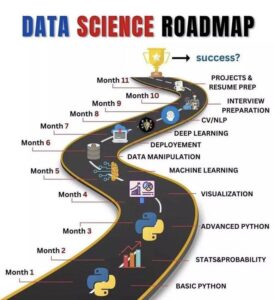
To begin with, this roadmap is divided into six stages: Excel and data basics, Python, pandas and data analysis, machine learning, specialisation, and portfolio development with job search. Furthermore, it maps each stage to Abuja Data School courses and free tools. As a result, by the end of the roadmap, you will have one clear learning path and one practical next step to advance your data career.
Why Nigerian Beginners Need a Clear Roadmap
Data science is a wide field. Without a roadmap, most Nigerian beginners get lost. They jump between YouTube videos, try random Udemy courses, learn things out of order, and give up after a few months. The key problem is not a lack of content. It is a lack of a clear path.
Also, the Nigerian data science job market has specific requirements. Abuja banks want pandas and SQL. Lagos fintechs want Python and ML. Abuja NGOs want Excel, Power BI, and data storytelling. In short, a roadmap that works for a Nigerian data science career must reflect what Nigerian employers actually hire for.
The Complete Data Science Roadmap for Nigerian Beginners
Stage
What to Learn
Key Output
1
Excel: data entry, formulas, pivot tables, basic charts
Clean, analyse, and chart a Nigerian data set in Excel
Trained, evaluated ML model on Nigerian data on GitHub
6
Specialise + build portfolio + job search
3-5 project GitHub portfolio, LinkedIn, first Nigerian role
In short, every stage builds on the one before. Also, every stage produces a real output you can put on GitHub. In short, by Stage 6, you have a live Nigerian data science portfolio that any Abuja or Lagos employer can review.
Stage 1: Excel and Data Basics
Excel is the entry point and is listed on almost every Nigerian analyst job ad. Every Nigerian data analyst role lists Excel as a core requirement; banks, NGOs, and government agencies all run on it. Start here.
Pivot tables: summarise large Nigerian data sets in seconds.
Charts: bar charts, line charts, and pie charts for Nigerian reports.
Conditional formatting: highlight key values in a Nigerian bank data set.
Data cleaning in Excel: remove duplicates, fix formats, fill blanks.
Also, Power BI is a strong add-on at this stage for Nigerians in NGOs, government, or consulting. A basic Power BI dashboard is a strong first portfolio piece. In short, strong Excel and Power BI skills are the fastest way for any Nigerian to get a first data role and start earning while learning more advanced skills.
Stage 2: Python Basics
Python is the core language of data science and is used in every Nigerian ML role. Learn it the right way: write real code from day one.
What to cover:
Variables and data types: strings, integers, floats, booleans.
Lists, dictionaries, and sets.
For loops, while loops, and if/else statements.
Functions: define your own reusable blocks of code.
File I/O: open, read, and write CSV and text files.
Error handling: try/except blocks.
Use Google Colab. It is free, runs in your browser, and has all key libraries pre-installed. No setup is needed. Also, practise on Nigerian data from the start: read a CSV of Abuja transactions, filter it, and print a summary. In short, apply every concept to a Nigerian problem from your first week of Python.
Stage 3: pandas, NumPy, and Data Visualisation.
This stage is the most important for Nigerian data analyst roles. pandas is the core tool for every data scientist and analyst in Nigeria.
What to cover:
pandas: Load CSVs, filter rows, group by, aggregate, join data frames, handle missing values, sort, and reset index.
NumPy: Array operations, broadcasting, and vectorised maths on Nigerian data columns.
Matplotlib and Seaborn: Bar charts, line charts, histograms, heatmaps, and scatter plots.
Exploratory data analysis (EDA): A full EDA workflow: load data, check shape and types, count missing values, plot distributions, find correlations.
Key output: a full EDA Jupyter notebook on a real Nigerian data set pushed to GitHub. This is one of the most powerful early portfolio pieces for any Nigerian data scientist. Also, Kaggle has free Nigerian and African data sets you can use. In short, your Stage 3 output is your first proof that you can do real data analysis on Nigerian data.
Stage 4: SQL
SQL is required for most Nigerian data analyst and data scientist roles. Banks, fintechs, NGOs, and government agencies all store their data in relational databases.
What to cover:
SELECT, WHERE, ORDER BY, LIMIT.
GROUP BY and aggregate functions: COUNT, SUM, AVG, MAX, MIN.
JOINs: INNER JOIN, LEFT JOIN, and RIGHT JOIN.
Subqueries and common table expressions (CTEs).
Window functions: ROW_NUMBER, RANK, LEAD, LAG.
Also, practise in a Nigerian context: write SQL queries to find total loan disbursements by state, average transaction size by day, and top 10 Abuja customers by spend. In short, SQL is the bridge between Nigerian raw data and Nigerian business questions.
Stage 5: Machine Learning with scikit-learn
Once you have Python, pandas, and SQL, you are ready for machine learning. This stage is where data analysts become data scientists.
What to cover:
Supervised learning: Linear regression, logistic regression, decision trees, random forests, XGBoost.
Model evaluation: Accuracy, precision, recall, F1, AUC-ROC, confusion matrix.
Pipelines: Chain preprocessing and modelling into a clean, reproducible sklearn Pipeline.
Feature engineering: Create, transform, encode, and select features from Nigerian data.
Key output: a full ML model on a real Nigerian data set pushed to GitHub with a model card explaining what it does, what data it used, and how it performs. In short, your Stage 5 output is the strongest single item in your Nigerian data science portfolio.
Stage 6: Specialise, Build Your Portfolio, and Get Your First Nigerian Role
By Stage 5, you have a marketable skill. This final stage is about making it visible and getting hired.
Specialise in One Area
Pick one area to go deeper:
NLP: If you want to work on Nigerian language data, chatbots, or document analysis.
Computer vision: If you want to work on AgTech, healthcare imaging, or ID verification.
MLOps and cloud: If you want to deploy models and build production Nigerian AI systems.
Data engineering: If you want to build the data pipelines that feed ML models.
Business intelligence: If you want to focus on Power BI, dashboards, and Nigerian business reporting.
Build Your GitHub Portfolio
For every Nigerian and global data science role, GitHub is used as your CV. Aim for 3 to 5 strong projects:
An EDA project on a Nigerian dataset.
One supervised ML model with a clear Nigerian business problem.
An unsupervised project (customer segmentation or anomaly detection).
One SQL analysis project with a Nigerian business context.
One domain project in your specialisation area.
Also, each project needs a clear README explaining the problem, the data, your method, and your key findings. In short, an Abuja employer looking at your GitHub should understand your work in 2 minutes.
Build Your LinkedIn Profile
A strong LinkedIn profile ensures you are found by Nigerian and global recruiters. Update it with every project you push to GitHub. Also, connect with Nigerian data science communities. Moreover, follow Abuja Data School, Nigerian data science groups, and the top Nigerian tech firms. In short, your LinkedIn is your passive job search running 24 hours a day.
Free Resource: Kaggle Learn
In addition to Abuja Data School’s live training, Abuja Data School recommends Kaggle Learn as the best free resource for every stage of this Nigerian data science roadmap. Kaggle offers free, structured micro-courses in Python, pandas, data visualisation, SQL, feature engineering, ML, and deep learning. Also, all courses run in free Kaggle notebooks with no install. Moreover, each course awards a free Kaggle cert. As a result, a Nigerian beginner who works through Kaggle Learn alongside Abuja Data School’s live courses will have both free global cert credentials and the live Nigerian project experience that Abuja employers value most.
Use Kaggle Learn for free, structured supplementary practice. Abuja Data School provides live instruction, real Nigerian data, career support, and the portfolio that gets you hired.
Nigerian Data Science Expectations by Stage
Role Target
Stage Reached
Junior Data Analyst
Stage 3 complete
Data Analyst
Stage 4 complete
Junior Data Scientist
Stage 5 complete
Data Scientist / ML Engineer
Specialised (NLP/MLOps)
Senior ML Engineer
Senior / Remote
How Abuja Data School Covers This Roadmap
Abuja Data School covers every stage of this roadmap in its live, project-based courses. Here is the mapping:
1: Excel and Power BI: Data Analysis and Power BI courses.
2: Python basics: Python for AI course
3: pandas and EDA: Data Science with Python course.
Frequently Asked Questions: Data Science Roadmap Nigeria
Q1: How Long Does This Roadmap Take?
For a Nigerian professional studying part-time (weekends and evenings), Stages 1 to 5 takes it time. Also, Abuja Data School’s courses mean you never need to quit your current job.
Q2: Do I Need a Maths or Computer Science Degree?
No. Teachers, nurses, accountants, civil servants, and business owners have all been trained at Abuja Data School with no prior coding background. What matters is your drive to learn and your consistency. In short, your background does not limit you. Your habits do.
Q3: What Is the Most Important Stage?
Stage 3 (pandas and EDA) is the most important for getting your first Nigerian data role. Most entry-level analyst jobs in Abuja and Lagos test for exactly this skill. Also, Stage 5 (ML) is the most important for moving from analyst to data scientist pay levels. In short, master pandas first. Add ML second.
Q4: Can I Skip Excel and Go Straight to Python?
Yes, but most Nigerian employer roles still test for Excel. A joint Excel and Python skill is stronger than Python alone for most Abuja data analyst roles. In short, do not skip Excel unless you are targeting roles that explicitly require only Python and SQL.
Your Data Science Journey in Nigeria Starts Today: Abuja Data School Is Ready
Ultimately, the Nigerian data science job market is wide open. Banks, fintechs, NGOs, and government agencies all need trained data professionals. The roadmap is clear. The tools are mostly free, the training is available, and the only thing left is the decision to start.
Whether you are at Stage 1 or Stage 4 right now, Abuja Data School has the right course for your current level and your next career goal. Live classes, real Nigerian data, career support, and a strong nationwide Nigerian learning community are all waiting for you.
Start Your Nigerian Data Science Journey at Abuja Data School Today
To that end, do not wait for a perfect moment. Indeed, every Nigerian data scientist now earning or working remotely for a global tech firm started with one course at Abuja Data School. Yours can begin this week. So, visit the Abuja Data School Data Analysis page today, pick your stage, and apply. As a result, your first data skill, your first data project, and your first data science income in Nigeria are just one enrolment at Abuja Data School away.