
Are you confused about the difference between TCP and UDP? If so, your search ends here. Abuja Data School is Nigeria’s top live technology training centre. In fact, TCP and UDP are the two main transport layer protocols used on the internet. Every Nigerian who uses WhatsApp, watches YouTube, sends email, or plays an online game is using either TCP or UDP, often both at the same time. Understanding the difference between them is core knowledge for any CCNA student or network professional in Nigeria.
So, this guide explains what TCP and UDP are, how each one works, why you would choose one over the other, and which Nigerian applications use which protocol. In addition, it covers the TCP three-way handshake in plain English. As a result, by the end, you will have a clear, working understanding of both protocols.

What Is a Transport Layer Protocol?
The transport layer (Layer 4 of the OSI model) is responsible for moving data between applications on different devices. It sits above IP (which routes packets between devices) and below the application layer (which is where your WhatsApp or browser runs).
The transport layer’s job is to take data from an application, break it into segments, send those segments to the right destination, and reassemble them at the other end. TCP and UDP are the two main ways of doing this job. Also, both run on top of IP. In short, IP handles the routing. Delivery to the right application is handled by TCP or UDP.
What Is TCP (Transmission Control Protocol)?
TCP is the reliable, connection-oriented transport protocol. “Connection-oriented” means TCP establishes a connection before sending any data, and closes it properly when done. Also, TCP guarantees that every segment arrives, that it arrives in order, and that it is error-free. If a segment is lost, TCP asks for it to be sent again.
In short, the key features of TCP are:
- Connection-oriented: A session is opened and closed formally (three-way handshake + four-way teardown).
- Reliable: Every segment is acknowledged. Lost segments are retransmitted automatically.
- Ordered: The receiver numbers and reassembles segments in the correct sequence.
- Error-checked: Every TCP segment carries a checksum. Corrupted segments are rejected and re-requested.
- Flow control: TCP adjusts the sending rate based on how fast the receiver can process data.
- Congestion control: TCP slows down on detecting congestion to avoid overwhelming the path.
In short, TCP is the careful, reliable courier. It will not declare a delivery done until every item is confirmed received.
The TCP Three-Way Handshake
Before any data is sent over TCP, a three-step connection is made between sender and receiver. This is called the three-way handshake:
- Step 1: SYN: The client (e.g. your Abuja laptop) sends a SYN (synchronise) packet to the server: “I want to connect.”
- Step 2: SYN-ACK: The server replies with a SYN-ACK (synchronise-acknowledge). The reply is: “I received your request, and I am ready.”
- Step 3: ACK: The client sends an ACK (acknowledge). The reply is: “Great. Let’s go.”
Data flows only after this handshake completes. Also, to close the connection, a four-step teardown is performed: FIN, FIN-ACK, FIN, ACK. In short, the three-way handshake is TCP’s way of making sure both sides are ready before any data is sent.
What Is UDP (User Datagram Protocol)?
UDP is the fast, connectionless transport protocol. It sends data without establishing a connection first and without waiting for acknowledgement. If a segment is lost, UDP does not retransmit it. The data is simply gone.
In short, the key features of UDP are:
- Connectionless: No handshake. Data is sent immediately without establishing a session.
- Unreliable: No guarantee that segments arrive. No retransmission of lost data.
- Unordered: Segments may arrive out of sequence, and UDP does not reorder them.
- Fast and lightweight: No overhead from handshakes, acknowledgements, or retransmissions.
- Low latency: UDP delivers data as fast as the network allows, without waiting.
In short, UDP is the fast, loose courier. It sends everything at once and does not stop to check whether it arrived.
TCP vs UDP: The Full Comparison
| Feature | TCP | UDP |
| Connection | Connection-oriented (handshake required) | Connectionless (no handshake) |
| Reliability | Guaranteed delivery. Lost data is re-sent. | No guarantee. Lost data is gone. |
| Ordering | Segments reassembled in correct order | No ordering. Segments may arrive out of sequence. |
| Speed | Slower (overhead from acknowledgements) | Faster (no overhead) |
| Error checking | Full checksum + acknowledgement | Checksum only (no retransmission) |
| Flow control | Yes (adjusts for receiver speed) | No |
| Congestion control | Yes | No |
| Header size | 20+ bytes (larger) | 8 bytes (small) |
| Nigerian example | Online banking, email, web browsing | Live video, online gaming, DNS, VoIP |
When to Use TCP
In short, use TCP when accuracy and completeness matter more than speed. Here are the Nigerian use cases where TCP is the right choice:
- Online banking (GTBank, Zenith, Access): Every naira transfer must arrive completely and correctly. A lost packet in a payment transaction would be catastrophic. TCP guarantees it arrives.
- Email (SMTP, IMAP, POP3): An email must arrive whole and complete. The full email arrives before it shows in your inbox.
- Web browsing (HTTP/HTTPS): Every HTML file, CSS sheet, and image must arrive for the page to display correctly. TCP ensures the full page loads.
- File transfer (FTP, SFTP): Files must arrive byte-perfect. TCP retransmits any lost data.
- WhatsApp text messages: Messages must arrive in order and in full. WhatsApp handles text message delivery through TCP.
When to Use UDP
In short, use UDP when speed and low latency matter more than guaranteed delivery. Here are the Nigerian use cases where UDP is the right choice:
- WhatsApp and Zoom voice/video calls: A few lost voice packets matter less than the delay of waiting for retransmission. UDP keeps the call alive; TCP would cause stuttering.
- Live TV streaming and YouTube: Brief pixelation is acceptable. Waiting for a retransmission would pause the video. UDP keeps the stream flowing.
- Online gaming: A game needs your location and actions delivered as fast as possible. A slight error is acceptable. A delay is not. UDP is used for the real-time game state.
- DNS lookups: A DNS query is a short, single-exchange request. Using TCP for DNS would add unnecessary handshake overhead. UDP keeps DNS fast.
- DHCP: IP address assignment uses UDP because it needs to broadcast before a TCP connection is even possible.
A Nigerian Analogy: EMS Courier vs Dispatch Rider
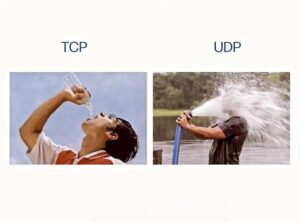
Think of TCP as EMS (postal) courier service. You send a package and get a receipt. The courier confirms it arrived. If it gets lost, they send another. Everything is tracked and guaranteed. Use TCP when your data must arrive perfectly.
Think of UDP as a dispatch rider on a Lagos expressway. They ride fast, deliver without stopping for confirmation, and do not come back if the delivery is missed. Use UDP when speed matters more than the occasional missed packet.
In short, both models have their place in Nigerian networking. Choosing the right one depends on what your application needs most: reliability or speed.
TCP, UDP, and the CCNA Exam
TCP and UDP are tested in the CCNA 200-301 exam. You need to know:
- The key features and differences between TCP and UDP.
- The TCP three-way handshake (SYN, SYN-ACK, ACK).
- Which protocols use TCP and which use UDP (see port numbers below).
- Common port numbers: HTTP (80), HTTPS (443), DNS (53 UDP/TCP), DHCP (67/68 UDP), FTP (21 TCP), SSH (22 TCP), SMTP (25 TCP).
In short, TCP vs UDP is a guaranteed topic in every CCNA exam sitting. Abuja Data School covers it in detail in the CCNA course with exam-standard practice questions.
Free Resource: Wireshark
Use Wireshark to see TCP and UDP live on your own network. Use Abuja Data School’s live CCNA course for the structured knowledge, lab practice, and exam preparation that get you certified and employed.
How Abuja Data School Teaches TCP and UDP
Abuja Data School’s CCNA course covers TCP and UDP in the transport layer module with live Saturday instruction, Packet Tracer labs, and Wireshark captures. Students observe real TCP handshakes and compare them to UDP traffic. Also, exam-standard questions on TCP vs UDP are covered in every mock exam session. In short, Abuja Data School builds the TCP/UDP knowledge that passes the CCNA exam and works in real Nigerian network engineering roles.
To enrol, visit the Abuja Data School Data Analysis page.
Frequently Asked Questions: TCP vs UDP
Q1: Is TCP Always Better Than UDP?
No. TCP is better when reliability matters. UDP is better when speed matters. There is no universally superior protocol. In short, the right choice depends on what your application needs. A banking app needs TCP; a live video call needs UDP.
Q2: Can TCP and UDP Run at the Same Time?
Yes. In fact, your device runs many network connections at once. Your web browser uses TCP. Also, your video call uses UDP. Your DNS queries use UDP. All of these run simultaneously on the same device. In short, TCP and UDP are not competing. They serve different needs and run in parallel.
Q3: Why Is UDP Faster Than TCP?
Also, UDP has much less overhead. There is no handshake, no acknowledgement, no retransmission, and no flow control. UDP just sends data immediately. The 8-byte UDP header is also much smaller than TCP’s 20+ byte header. In short, UDP is faster because it does far less work.
Q4: Does WhatsApp Use TCP or UDP?
WhatsApp uses both. Text messages use TCP to ensure they arrive. Voice and video calls use UDP for low latency. Also, the WhatsApp protocol adds its own reliability layer on top of UDP for calls to recover from brief losses without TCP’s overhead. In short, most modern Nigerian communication apps use whichever protocol fits each type of data.
TCP vs UDP Mastered Now Build Your CCNA at Abuja Data School
Ultimately, TCP and UDP are not competing standards. They are two different tools for two different jobs. Every Nigerian network engineer must understand both deeply. The CCNA exam tests both. Real Nigerian networks use both every second of every day. The Nigerians who understand the difference are the ones who build, maintain, and secure those networks.
To that end, take your next step today. Visit the Abuja Data School Data Analysis page and enrol in the CCNA course. As a result, TCP, UDP, and every other networking protocol will be clear, certified skills in your Nigerian tech career toolkit.